
How Can I Use AI to Write a Book: Complete Step-by-Step Guide for 2026
How can I use AI to write a book that question is reshaping the publishing world in 2026. A BookBub survey of 1,200-plus authors found that 45% now use generative AI in their writing workflow, and the results speak clearly: independent authors publish faster, professionals handle more projects simultaneously, and first-time writers who previously felt blocked by the blank page are completing full manuscripts. This guide walks through exactly how to use AI at every stage, which tools deliver the best results, and the habits that separate publishable AI-assisted books from generic content readers abandon in the first chapter.
What AI Can and Cannot Do for Your Book
Setting accurate expectations prevents the two most common mistakes expecting too much and expecting too little. According to the complete AI book writing workflow published by Inkfluence AI, the best AI book writing platforms don’t replace authors they collaborate with them, handling the heavy lifting of drafting while you provide direction, voice, and editorial judgment.
- AI excels at first-draft generation, structural outlining, research synthesis, and overcoming blank-page paralysis
- AI struggles with deeply personal narrative voice, emotional nuance, and genuinely original insights that only lived experience produces
- The most effective approach treats AI as a drafting partner rather than a ghostwriter producing finished content
- Every AI-assisted manuscript requires 10 to 20 hours of human editing before reaching professional publication quality
Match the Right AI Tool to Your Book Type
How you use AI to write a book depends fundamentally on what kind of book you are writing. For non-fiction authors, Inkfluence AI’s blueprint system structures your book by type before generating content producing more coherent chapter sequences than general-purpose chatbots. For fiction writers, Sudowrite’s Muse 1.5 model, fine-tuned on published novels, produces narrative prose quality that consistently outperforms general AI models for scene description and dialogue. NovelCrafter lets you maintain character bibles and world-building documents the AI references automatically solving the consistency problem that derails most long-form AI fiction projects.
For writers on a budget, Claude’s free tier provides the strongest raw prose quality with a 200,000-token context window handling entire chapters without losing earlier context. ChatGPT handles outlining, research synthesis, and first-draft generation across virtually every genre. Full details on platforms across every budget are available through this AI book writer tool guide covering paid platforms by genre and use case, and free options are covered in this free AI book writer generator guide with setup instructions for zero-cost workflows.
Build Structure Before Generating Any Content
The most common reason AI-assisted books produce disappointing results is generating content before establishing a detailed structural foundation. According to AI book writing best practices compiled by Dupple’s 2026 AI book writing guide, authors should draft sequentially chapter by chapter with detailed briefs for each section not dump the full manuscript request into a single prompt.
- Write a chapter-by-chapter outline before generating any prose even one paragraph per chapter transforms output quality dramatically
- Define your target reader and what they gain from reading before writing any content prompts
- For fiction, document character backstories, motivations, and plot points before writing the first scene
- Feed the AI the previous chapter summary and the next chapter goal at the start of every generation session
Use the Right Prompting Strategy Throughout
Learning how to use AI to write a book effectively comes down significantly to prompt quality. Three principles consistently produce stronger output across every tool and book type. First, specify each chapter’s precise role in the larger narrative or argument structure. Second, provide writing samples so the AI matches your vocabulary, sentence rhythm, and tonal preferences. Third, generate in 500 to 800 word sections rather than complete chapters — smaller batches maintain quality and allow immediate review before continuity errors compound. The single highest-impact addition to any prompt is a clearly defined reader: “busy parents who want to start exercising at home” produces dramatically better output than “people interested in fitness.”
Maintain Your Voice Throughout the Writing Process
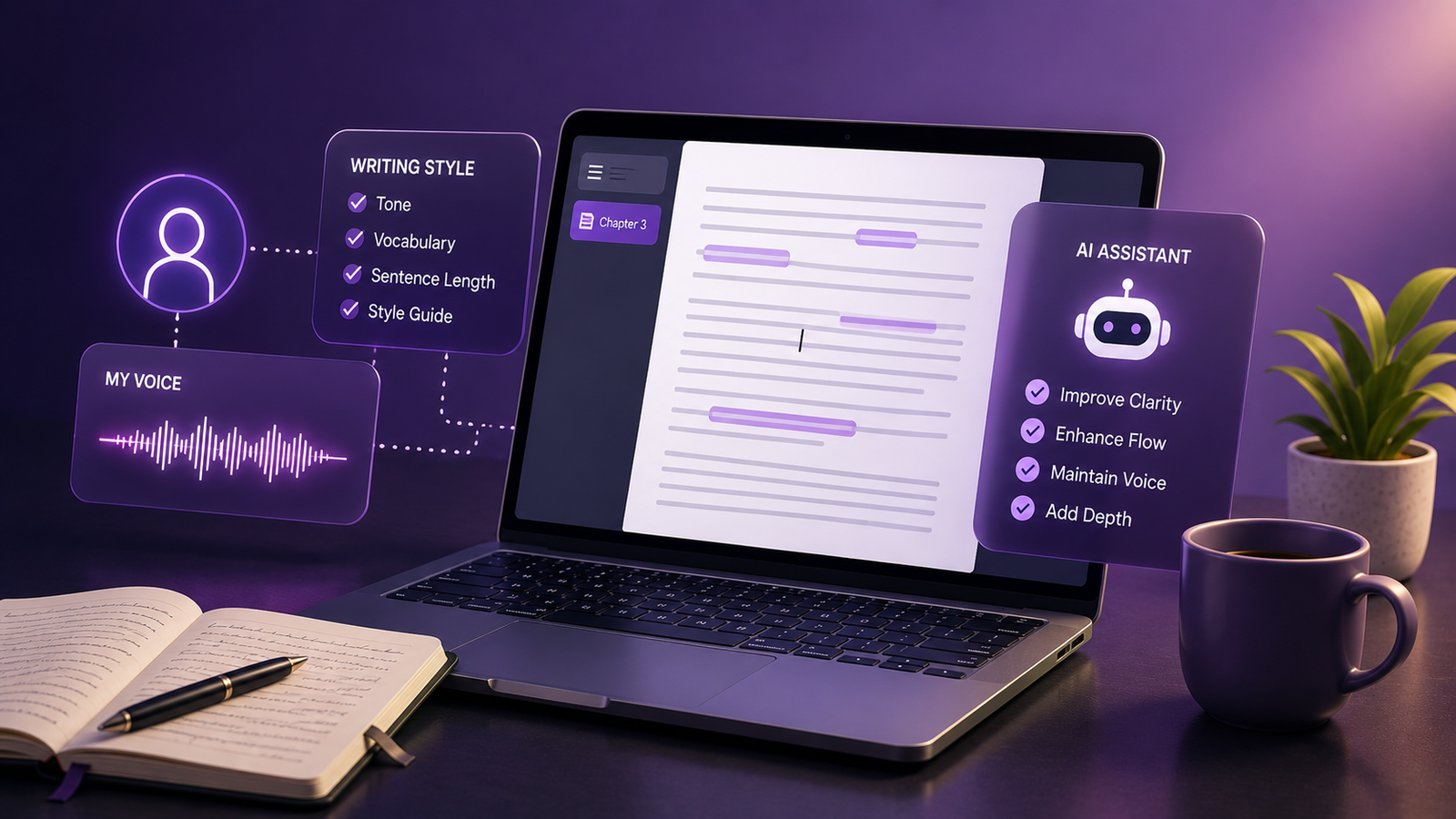
Voice preservation requires active input at every stage rather than passive acceptance of whatever AI generates. The authors who succeed with AI are those who understand it amplifies human creativity rather than replacing it your ideas, your voice, and your vision remain irreplaceable throughout the process.
- Provide three to five samples of your own writing before starting generation for accurate style matching
- Read every generated section aloud immediately vocal reading reveals unnatural phrasing that silent reading consistently misses
- Add at least one personal anecdote, specific example, or original observation to every generated section before moving forward
- Edit for your distinctive sentence length patterns correct AI’s tendency toward longer constructions if your natural style is punchy and direct
Research Verification for Non-Fiction Books
Non-fiction authors need a research verification workflow running parallel to content generation. AI tools produce confident-sounding factual claims that occasionally contain errors, outdated statistics, or misattributed quotes. As Wiley’s official AI writing guidance for book authors emphasizes on the Wiley author AI guidelines page, authors remain fully accountable for accuracy regardless of which tools assisted in drafting making independent verification of every specific statistic, named study, and expert quote essential before submission.
- Run every AI-generated statistic or expert quote through Perplexity AI before accepting it as accurate
- Treat content generation and fact verification as simultaneous parallel processes rather than sequential steps
- Mark every claim you wouldn’t defend in a public interview and either verify it, rewrite it, or cut it
- Have a subject matter expert review chapters covering technical areas outside your core expertise
Build an Editing Workflow Around AI Output
Generation is only the first half of the process. Professional editors reviewing AI-assisted manuscripts in 2026 identify the same recurring issues: inconsistent character behavior across chapters, logic gaps in argument structure, overuse of transitional filler phrases, and tonal drift between sessions where the AI shifted register without the author noticing.
- Run a consistency pass before a quality pass check character names, timeline accuracy, and argument continuity before evaluating prose quality
- Flag every section accepted without revision during generation and give those sections extra editorial scrutiny
- Use ProWritingAid or Hemingway App for objective readability analysis rather than relying entirely on personal judgment during self-editing
- Get at least one beta reader review fresh eyes catch continuity issues that author familiarity consistently misses regardless of how carefully you self-edit
Publishing Requirements for AI-Assisted Books
Amazon KDP requires AI content disclosure during the publishing process books are not rejected for AI assistance but are rejected for poor quality, plagiarism, and missing disclosure. IngramSpark and most traditional publishers now have explicit AI content policies requiring review before submission. Copyright for AI-assisted books remains with the human author in most jurisdictions when meaningful human creative contribution exists throughout. The practical rule is clear: the more heavily you edit, restructure, and personalize AI output, the stronger your copyright position and the better your book.
Final Analysis
How can I use AI to write a book the answer in 2026 is more accessible than most writers expect and more nuanced than AI marketing suggests. AI works best as a structured drafting partner that accelerates the mechanical production layer of writing while the human author contributes judgment, voice, expertise, and editorial vision. The workflow that consistently produces strong results is the same across every book type: detailed structure before generation, voice samples before drafting, small-batch content creation with immediate review, parallel fact verification for non-fiction, and genuine editorial investment in transforming the AI-assisted draft into a polished manuscript readers want to finish.
Frequently Asked Questions
How long does it take to write a book using AI assistance?
A 50,000-word non-fiction book with AI assistance typically takes three to six weeks for generation and editing combined, compared to three to six months manually. Fiction timelines vary more widely based on genre complexity and revision depth. The time saving is largest in first-draft generation AI compresses the slowest phase into the fastest, while human editing remains the primary time investment regardless of AI assistance level.
Which AI tool is best for a complete beginner writing their first book?
Inkfluence AI’s blueprint system is the strongest starting point for non-fiction first-time authors its structured approach prevents the architectural errors that cause most first books to fail before the writing even begins. Claude’s free tier is the strongest starting point for fiction beginners because its prose quality reduces the editing burden for writers who don’t yet have advanced revision skills to significantly improve weak AI output.
Do I need to disclose that I used AI when publishing my book?
Amazon KDP requires AI content disclosure through a dedicated field during the publishing process in 2026. IngramSpark and most traditional publishers require policy review before AI-assisted submission. Disclosure is mandatory but does not result in rejection when quality standards are met and disclosure fields are completed accurately. Non-disclosure when required carries more risk than the disclosure itself.
How do I maintain my voice when using AI to write a book?
Provide writing samples from your existing work before generating content most platforms adapt their output to replicate your sentence rhythm, vocabulary preferences, and tonal patterns from examples you supply. Then add personal observations and specific details to every generated section before accepting it. The combination of style-trained generation plus human specificity additions consistently produces manuscripts that sound authentically authored rather than obviously AI-generated to readers familiar with both styles.

- How to Add Captions to Short Videos That People Actually Read - October 8, 2026
- 10 Step AI Search Content Optimization Checklist - October 6, 2026
- Competitor Visibility Tracker: How to Monitor Search and AI Visibility - August 22, 2026