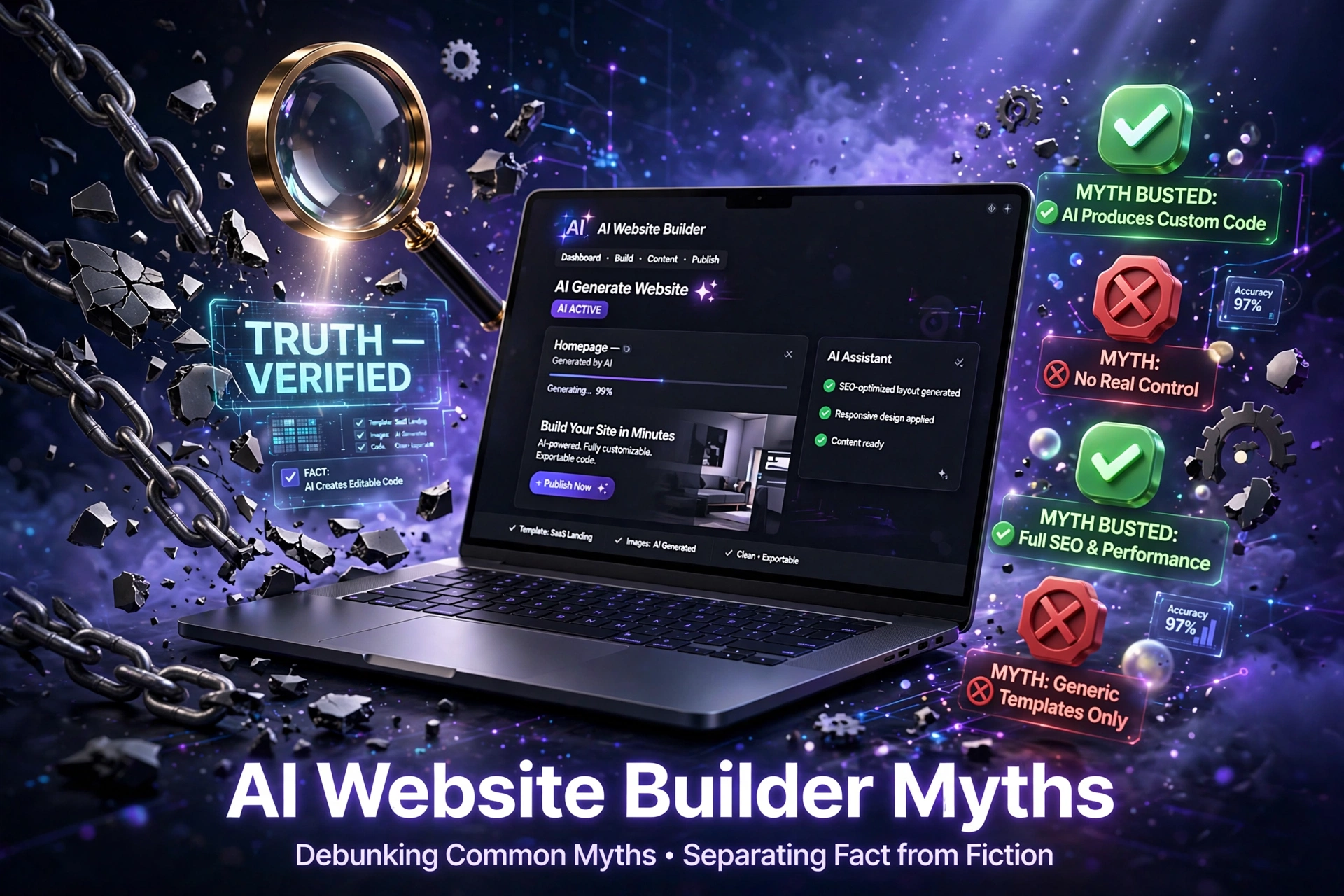
AI Website Builder Myths: 6 Claims Tested Against What Actually Happens
The conversation about AI website builders has two camps, and both exaggerate. The enthusiasts claim AI will build you a perfect website in minutes, no skills needed. The skeptics claim every AI-built site looks identical, ranks nowhere, and insults the craft of real design. Most of the myth-busting articles online pick one camp: they either declare every myth “busted” in the builder’s favor or use the myths as an excuse to sell you an agency.
This article takes a less comfortable route. Some of these AI website builder myths contain a core of truth, and pretending otherwise does readers no favors. What follows is six common claims about AI website builders, each tested against what actually happens when real people use these tools, with the honest version of each. At the end, you get a practical workflow that uses AI for what it is good at and keeps a human in charge of what it is not. Learning to separate ai website builder myths from reality is the best place to start.
Myth 1: Every AI-Built Website Looks the Same
The honest answer is that this one is half true. If you type a one-line prompt into a builder, accept the first draft, change nothing, and publish, your site will look like thousands of others built from similar prompts. AI builders start from pattern libraries and learned design conventions, so the defaults genuinely are similar. The “generic AI look” is not a hallucination of critics; it is what the defaults produce.
But the myth falls apart the moment you do any real work. Builders like Framer, whose 3.0 release added agent-mode generation directly on an editable canvas, and Wix’s AI builder give you full editing control after generation. Change the type scale, replace the stock imagery with your own, rewrite the sections in your own voice, and the result is yours in every meaningful sense. The myth mistakes laziness for destiny. AI gives you the same starting ingredients as everyone else; what you cook with them is the difference.
Most ai website builder myths about sameness confuse the starting template with the finished site. For a broader look at what these platforms can and cannot do, see our comparison of AI website builder platforms.
Myth 2: AI-Generated Content Is Always Low Quality
The phrase “AI slop” exists for a reason, and it feeds some of the most persistent ai website builder myths. Unedited AI copy is recognizable: the same sentence rhythms, the same safe generalities, the same confident vagueness. Publishing it unchanged is a quality problem and, frankly, a respect problem toward your visitors.
The myth breaks down at “always.” AI-generated drafts are a starting point, not a finished product, and as a starting point they are excellent: they defeat the blank page, structure an argument, and produce a first pass in minutes that would take a human hours. The quality of the final page is decided by the editing pass, and that pass is non-negotiable.
Check every factual claim, rewrite the voice into yours, cut the filler, and add the specifics only you know: your prices, your process, your results, your perspective. Content that goes through that process is not low quality; it is just content. The builders do not do this for you, and anyone who tells you they do is selling something.
Myth 3: AI Website Builders Are Bad for SEO
This is the myth that needs the most careful handling, because both sides misstate it. The claim “AI-built sites rank fine automatically” is false, and the claim “Google penalizes AI-built sites” is also false. Google’s position is consistent and public: what matters is helpful, reliable, people-first content, as described in its Search Essentials, and its spam policies target manipulative behavior, not the tools used to create a page. That single distinction deflates a whole shelf of ai website builder myths about search penalties.
This is the nuanced truth. Modern AI builders handle the technical SEO basics competently: clean code, mobile responsiveness, sitemaps, meta tags, decent page speed. That part of the myth is genuinely busted; a 2026 builder site is not technically broken out of the box. What no builder’s AI does for you is earn rankings. Rankings come from content people actually want, pages that load fast and satisfy intent, and the authority signals that come from other sites linking to you. An AI SEO checklist inside the builder helps with the technical layer; it does not substitute for the work.
And thin, mass-generated pages published at scale are exactly what the spam policies exist to catch, regardless of which tool generated them. If you want to check how your titles and descriptions will look in search results before publishing, a free SERP preview tool is more useful than any AI SEO promise.
Myth 4: AI Can Build a Complete Website Entirely on Its Own
This is the marketing version of the story, and it collapses on contact with reality. AI generates a draft: layout, placeholder copy, stock images, a color scheme that does not embarrass anyone. What it cannot do is know your business. It does not know which offer converts, which objection your customers raise on calls, which pages your analytics say are leaking visitors, or what your brand actually sounds like when it is not averaging the internet.
Every practitioner who has shipped a real site with these tools reports the same pattern: the AI saves the first forty percent of the work, the human does the remaining sixty. The realistic expectation is not “prompt to published” but “prompt to draft, human to finished.” Anyone selling the fully automatic version is selling the demo, not the product. That gap between the demo and reality is where most ai website builder myths are born.
Myth 5: AI Builders Will Replace Web Designers and Developers
AI website builders have replaced something real: the blank-page problem, the five-thousand-dollar quote for a simple brochure site, the weeks of waiting for a first draft. For simple sites, that is a genuine shift, and designers who only sold basic brochure sites have felt it.
What has actually happened is a reshuffling. Designers now spend less time on layouts anyone could generate and more on the decisions that determine whether a site works. The new generation of builders points this way too: Wix’s Harmony, launched in early 2026, pairs prompt-based generation with traditional drag-and-drop editing precisely because the human step turned out to be load-bearing. AI did not replace the designer; it fired the designer’s most boring hours. The ai website builder myths about disappearing jobs mistake task automation for role replacement.
Myth 6: AI Website Builders Are Too Expensive for Small Businesses
This myth is mostly stale. The pricing landscape in 2026 is tiered: free plans that are genuinely usable for a simple presence, affordable entry tiers, and premium plans for stores and advanced features. The honest comparison is not builder versus nothing; it is builder versus hiring someone. A small business owner who would otherwise pay a freelancer for a basic site usually comes out ahead with a builder, provided they budget the time to do the human part of the workflow below. The ai website builder myths about cost usually compare the wrong things.
Where cost surprises do happen is in the upsells: removing builder branding, connecting a custom domain, storage limits, transaction fees on stores. These are disclosed on pricing pages but easy to miss when you are excited by a free plan. Our breakdown of AI website builder pricing walks through what the tiers actually include, so check the real numbers before you commit.
A Realistic AI-Plus-Human Workflow

If the myths above leave you with “useful tool, human required,” here is what that looks like in practice. It is also where the remaining ai website builder myths go to die.
- Generate the draft. Prompt the builder with specifics about your business, not generic industry words. Give it your actual services, your city, your differentiators. The better the input, the less generic the draft.
- Make it yours. Replace stock imagery with real photos or brand-consistent visuals, rewrite every section in your own voice, and fix the type scale and colors until it looks like your business rather than a template.
- Check every fact. AI copy invents details with total confidence. Verify addresses, prices, service lists, and claims before anything goes public.
- Do the SEO basics yourself. Write real title tags and meta descriptions for your important pages, make sure each page targets one clear topic, and submit your sitemap to Google Search Console. The builder’s technical foundation handles the rest.
- Publish, measure, iterate. Connect analytics, watch where visitors drop off, and improve the pages that matter. A website is not a one-time build; it is an asset you tune. The AI got you to the starting line faster, which only matters if you keep running.
AI Website Builder Myths: Quick Answers Before You Pick a Builder
Do AI website builders create generic-looking websites?
They create generic-looking drafts. Whether the published site looks generic depends entirely on how much you customize it. Accept the defaults and it will look like everyone else’s defaults; do real design work on top and it will not.
Is AI-generated website content bad for SEO?
Not inherently. Google evaluates whether content is helpful and reliable, not which tool produced it, per its Search Essentials and spam policies. Unedited, thin AI content performs badly because it is thin, not because it is AI. Edited, specific, genuinely useful content ranks on its merits.
Do I need technical skills to use an AI website builder?
For a basic site, no, but prompt quality matters enormously: vague prompts produce vague sites. For anything beyond basics, custom domains, analytics, and integrations, a little technical comfort helps. You do not need to code, but you do need to think.
Are websites built with AI secure?
Security depends on the platform’s infrastructure, not on whether AI generated the pages. Major builders handle patching, SSL, and hosting security for you, which is generally better than a self-managed setup by a non-technical owner. Keep your account credentials strong and enable two-factor authentication wherever offered.
The Sensible Middle Ground
The myths fail because they demand a single verdict on a tool that is genuinely two things at once: a remarkable starting point and an incomplete finish. AI website builders in 2026 are good enough that a careful owner can ship a professional site without hiring anyone, and limited enough that a careless owner can ship a generic one that converts nothing.
The difference was never the builder. It is the human pass: the editing, the facts, the voice, the measurement. Treat the AI as the fastest junior designer you have ever hired, one who works for free and needs everything checked, and you will get your money’s worth out of it. The tool is neutral. The workflow is everything. Once you look past the loudest ai website builder myths, the choice becomes practical rather than ideological.

- How Many Weeks Between Two Dates? A Simple, Accurate Guide - October 16, 2026
- What Elements Are Foundational for SEO with AI? The Two-Layer Framework for 2026 - October 15, 2026
- 9 Best HARO Alternatives in 2026 (After HARO Shut Down) - October 15, 2026