
AI Tools Automate Security Questionnaires: 20 Best Platforms in 2026
AI tools automate security questionnaires at a scale and speed that manual processes cannot match in 2026. The average enterprise security team spends 35 hours completing each security questionnaire and receives dozens per quarter. Vendors, procurement teams, and compliance officers are drowning in repetitive, time-consuming review cycles that delay deals, slow procurement, and exhaust security professionals who should be focused on actual risk management rather than form completion. Based on Sprinto’s Vendor Category Landscape 2026 study scoring 47 governance criteria across vendor categories, the shift from manual data entry to automated trust ecosystems is no longer optional it is the new baseline for competitive enterprise operations.
This guide covers 20 of the most capable platforms automating this workflow right now across every team size, budget, and compliance requirement.
Why AI Tools Automate Security Questionnaires Better Than Manual Teams
The fundamental problem with manual security questionnaire completion is not skill it is scale. Most security teams handle the same questions repeatedly across every vendor relationship, answering identical queries about SOC 2 status, data encryption standards, access control policies, and incident response procedures dozens of times per year with marginal variation between responses.
- AI tools automate security questionnaires by building a knowledge library from past responses and matching new questions to existing approved answers automatically
- Completion time drops from 35 hours per questionnaire to under two hours for most teams after initial knowledge base setup
- Consistency improves because AI applies the same approved language every time rather than relying on individual analyst interpretation
- Sales cycle velocity increases because security reviews no longer sit as unresolved blockers in late-stage deals
- AI handles the 70 to 90 percent of questions that repeat across questionnaires while routing novel items to subject matter experts for human judgment
The Purpose-Built AI Agent Standard for Questionnaire Completion
Iris AI approaches security questionnaire automation with a knowledge ledger architecture that treats institutional knowledge as a living, connected system rather than a static document database. Upload a security questionnaire in any format Excel, PDF, or portal and Iris parses every question, auto-fills answers from a verified knowledge base, and assigns each answer a confidence score that routes low-confidence items to the right subject matter expert without manual assignment. Teams using Iris report 70 to 90 percent of questions auto-filled on the first pass, reducing three-day completion cycles to three hours.
- Continuously syncs with Google Drive, SharePoint, Confluence, and Vanta for always-current knowledge base
- Confidence scoring routes only flagged items to human reviewers rather than every answer
- Parses Excel, PDF, and web portal questionnaire formats natively without reformatting
- 70 to 90 percent auto-fill rate on first pass confirmed across customer base
Full platform capabilities and customer case studies are available on the Iris AI platform, which provides detailed documentation of the confidence scoring system and knowledge base sync architecture.
The Self-Healing Knowledge Library Market Leader
Conveyor has built its reputation as the closest thing to a market leader in the AI tools automate security questionnaires category, with a self-healing knowledge library that flags gaps and inconsistencies automatically rather than requiring manual content maintenance. Its AI claims 95 percent-plus answer accuracy with a hallucination rate below 0.01 percent the most specific published accuracy number in this category. Customers including Figma, Atlassian, Zapier, and Carta have built their trust programs on Conveyor, and its browser extension handles portal-based questionnaires including OneTrust and Zip directly without copy-pasting between platforms.
- 95 percent-plus AI accuracy with hallucination rate below 0.01 percent most specific published benchmark in category
- Browser extension handles OneTrust, Zip, and other portal-based questionnaires natively
- Self-healing knowledge library surfaces gaps for review without requiring manual content audits
- Trusted by Figma, Atlassian, Zapier, and Carta for enterprise customer trust management
The Agentic Compliance Platform With Live Evidence
Sprinto operates as an Autonomous Trust Platform that centralizes trust requirements across security frameworks, security reviews, and vendor due diligence then runs the work continuously rather than periodically. Its questionnaire answers are pulled from controls Sprinto is actively verifying in real time, not from a document someone wrote in March. When an environment changes a new vendor added, a policy edited, or configuration drift detected Sprinto notices, refreshes the underlying compliance state, and keeps questionnaire answers up to date automatically without manual intervention from the security team.
- Live evidence pulls from continuously monitored controls rather than static documentation
- Environment changes trigger automatic questionnaire answer updates without manual refresh
- Combines questionnaire automation with proactive trust center that reduces inbound volume over time
- Supports SOC 2, ISO 27001, GDPR, HIPAA, and 15-plus additional frameworks natively
The Agentic Trust Platform for Startups and Mid-Market
Vanta is the most widely adopted platform for SaaS companies that need AI tools automate security questionnaires as part of a broader compliance automation suite. Its January 2026 Agentic Trust Platform launch added autonomous routing: questions requiring human input are automatically assigned to the right subject matter expert, with reminders sent and final approval looped back to the security lead. An IDC study confirms 81 percent faster review times for Vanta customers, with a published acceptance rate of 95 percent on AI-generated questionnaire responses.
- Autonomous routing assigns human-input questions to the right subject matter expert automatically
- 81 percent faster review times confirmed by independent IDC study across customer base
- AI trained on actual compliance evidence rather than uploaded documents for accuracy
- Standard tier supports 144 questionnaires per year with 288 on advanced plans
The AI-Plus-Human Hybrid With 12-Hour SLA
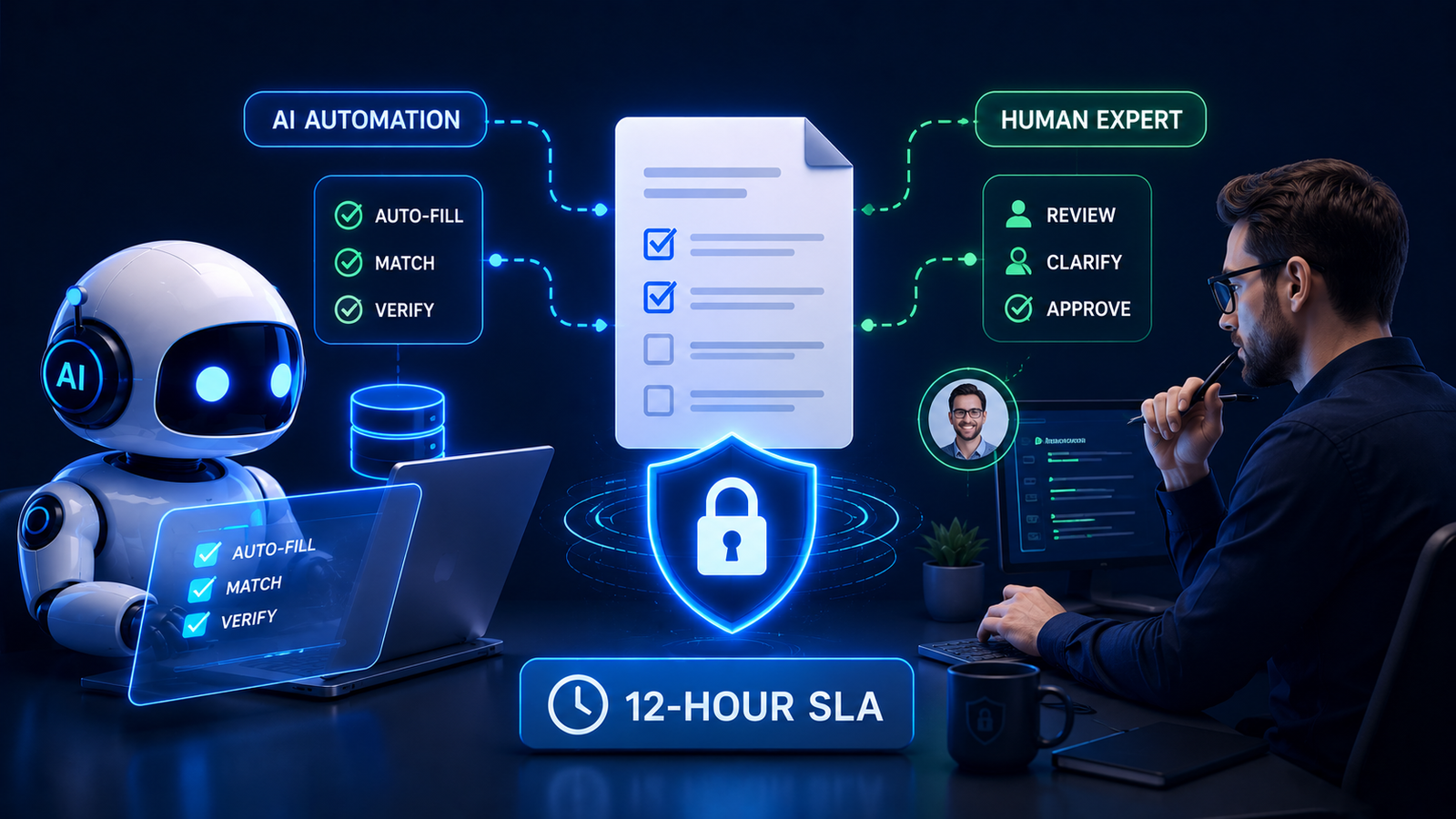
SecurityPal’s Assurance Management Platform combines AI Concierge Agents with 150-plus certified security experts to deliver fast, accurate, and defensible security reviews at scale.
Based on insights from more than three million security questions processed through its platform, SecurityPal has established the hybrid AI-plus-human model as the new standard for organizations that need both speed and defensibility where AI handles scale and repetition while human experts handle judgment, clarification, and context that cannot be derived from documentation alone. Its 12-hour SLA for questionnaire completion is the fastest guaranteed turnaround in the enterprise segment.
- 150-plus certified security experts validate AI-generated responses for defensible accuracy
- 12-hour SLA for questionnaire completion fastest guaranteed turnaround in enterprise segment
- Three million-plus security questions processed provide the largest training corpus in category
- Full lifecycle coverage including trust centers, TPRM, audit readiness, and contract redlines
The Zero-Library-Maintenance Platform for Google Workspace Teams
Arphie takes the most distinctive technical approach among AI tools automate security questionnaires platforms by eliminating knowledge base maintenance entirely. Rather than requiring teams to build, maintain, and regularly audit a separate content library, Arphie connects directly to existing Google Drive, SharePoint, Confluence, and Notion documents and generates questionnaire responses from those live sources without creating a parallel content repository that diverges from source truth over time.
- Zero library maintenance connects to existing docs rather than building a parallel content repository
- Generates responses directly from Google Drive, SharePoint, Confluence, and Notion
- Eliminates the most common implementation failure point: knowledge base drift from source documentation
- Particularly strong for teams already maintaining thorough internal documentation in Google Workspace
The Agentic Platform Handling Complex Portal Formats
Skypher has built its reputation on handling the questionnaire formats that other platforms struggle with Excel files with macros and conditional logic, Word documents with nested tables, and PDFs with embedded image data. Its Grounded AI Retrieval syncs directly with SharePoint, Google Drive, Confluence, and Notion, ensuring every answer is grounded in current company policies rather than AI inference. Skypher operates within existing enterprise tools, managing intake through Salesforce and handling subject matter expert reviews directly within Slack or Microsoft Teams without requiring respondents to log into a separate platform.
- Handles complex Excel macros, nested Word tables, and image-embedded PDFs natively
- Grounded AI Retrieval syncs with SharePoint, Google Drive, Confluence, and Notion simultaneously
- Slack and Teams integration routes SME reviews inside existing communication tools
- Unified Trust Center with automated NDA gating reduces inbound questionnaire volume over time
The Certification-First Platform Combining Compliance and Questionnaires
ComplyJet handles security questionnaire automation and SOC 2 or ISO 27001 certification in a single flat-fee platform starting at $5,000 per year making it the strongest value proposition for startups and growth-stage companies simultaneously pursuing certification and needing to accelerate customer security reviews. Because questionnaire responses are generated directly from certification evidence collected during the audit workflow, teams building their compliance program with ComplyJet create their questionnaire response library as a natural byproduct rather than a separate effort.
- SOC 2, ISO 27001, and HIPAA certification included alongside questionnaire automation in one flat fee
- Questionnaire responses generated directly from certification evidence without separate content work
- Starting at $5,000 per year most transparent pricing in the certification-plus-questionnaire category
- Ideal for startups that need both trust program infrastructure and sales cycle acceleration simultaneously
The Sales-Forward Questionnaire Completion Tool
HyperComply is built specifically for the sales use case within AI tools automate security questionnaires, where deal velocity depends on completing security reviews before competitor responses arrive. Its AI completes security questionnaires in under an hour for most standard frameworks, with a professional services fallback where HyperComply’s security analysts complete questionnaires the platform cannot fully automate. Direct Salesforce and HubSpot integration triggers questionnaire workflows from deal stage changes without manual handoff between sales and security teams.
- AI completes most standard security questionnaires in under one hour from receipt
- Professional services fallback covers questionnaires requiring human expert completion
- Direct Salesforce and HubSpot integration triggers security workflows from deal stage change
- Purpose-built for sales-security handoff rather than compliance-first workflow design
The Specialized Platform for Financial Institutions
Narad positions itself specifically around security questionnaires, vendor assessments, due diligence questionnaires, and RFPs with industry-specific positioning for financial institutions and NBFCs. Rather than treating questionnaire handling as a side feature of a broader compliance platform, Narad is built around the questionnaire workflow itself — generating accurate, reference-backed responses with claimed 90 percent reduction in manual effort. Its compliance-ready response templates for regulated financial environments address the specific question sets that banking and financial services procurement teams send most frequently.
- 90 percent reduction in manual effort claimed across customer questionnaire workflows
- Industry-specific positioning for financial institutions and NBFC compliance environments
- Reference-backed responses include source attribution for auditor review and validation
- Built around questionnaire workflow specifically rather than as a compliance platform add-on
The RFP and Questionnaire Unified Platform
Responsive combines RFP response automation with security questionnaire completion in a single platform that handles SIG, VSAQ, CAIQ, and NIST 800-171 formats alongside standard enterprise RFPs. Its AI-enabled content management surfaces the best answers from an internal knowledge base to improve speed and consistency, with multi-format intake covering Word, Excel, PDF, and portal-based questionnaires. Revenue teams that handle both sales proposals and compliance reviews within the same workflow benefit most from Responsive’s unified architecture rather than maintaining separate platforms for each document type.
- Handles SIG, VSAQ, CAIQ, and NIST 800-171 formats alongside standard RFP document types
- Multi-format intake covers Word, Excel, PDF, and portal-based questionnaires simultaneously
- Native integration with Salesforce, Slack, Microsoft Teams, and cloud storage platforms
- In-platform SME collaboration with task assignment and real-time progress tracking
A detailed comparison of Responsive against nine other platforms across real-world questionnaire volumes is available on the Inventive AI security questionnaire software comparison, which maps each platform to response quality, automation depth, and specific use cases with verified customer data.
The Trust Center Platform Reducing Inbound Volume
SafeBase has become a serious player in the AI tools automate security questionnaires category by combining questionnaire automation with a proactive trust center that reduces total inbound questionnaire volume over time. Its AI Questionnaire Assistance parses content from trust centers, knowledge bases, websites, and uploaded security artifacts then answers residual questionnaires quickly for the subset that buyers don’t self-serve. SafeBase states its AI-powered questionnaire assistance reduces completion time by 80 percent or more, and its visitor analytics show which prospects reviewed which security topics and for how long.
- Proactive trust center reduces total inbound questionnaire volume through buyer self-service
- AI parses trust center content, knowledge bases, and uploaded artifacts for answer generation
- 80 percent or more reduction in questionnaire completion time claimed across customer base
- Visitor analytics turn trust center engagement into buyer intent intelligence for sales teams
The Agentic TPRM Platform for Enterprise Vendor Portfolios
Drata made headlines in early 2026 with Agentic TPRM the most autonomous third-party risk implementation currently available among AI tools automate security questionnaires platforms. Its agentic system autonomously accesses vendor trust centers, submits access requests with explicit consent, ingests live trust artifacts, and converts findings into tracked risks and executive reports without manual configuration for each vendor relationship. SafeBase trust center capabilities are now natively integrated into Drata’s platform, covering both the inbound questionnaire response workflow and the outbound vendor assessment workflow in a single system.
- Agentic TPRM autonomously accesses vendor trust centers and extracts trust artifacts
- SafeBase trust center natively integrated for both inbound and outbound questionnaire workflows
- Converts vendor assessment findings directly into tracked risks and executive reports
- AI Trust Center Setup generates a complete mapped trust center from existing documentation in minutes
The Intelligent Proposal and Questionnaire Platform
Inventive AI is an AI-powered platform built to automate complex RFPs and security questionnaires with purpose-built agents that deliver context-aware answers rooted in an organization’s approved knowledge. Its brainstorming agent surfaces win themes and value messaging while a competitor research agent scans public data to reveal how rivals pitch and differentiate features that extend questionnaire automation into strategic sales positioning beyond pure compliance response. Cross-functional workspace with role-based access brings security, legal, sales, and technical teams into a shared environment for parallel review rather than sequential handoffs.
- Brainstorming agent surfaces win themes and competitor differentiation for strategic positioning
- Role-based workspace supports parallel review across security, legal, sales, and technical teams
- Context-aware answers rooted in approved organizational knowledge rather than generic AI training data
- Handles complex RFPs alongside security questionnaires in a unified agent-powered platform
The Content Reuse and Collaboration Standard
Loopio is a well-established option for teams that need to manage RFPs, DDQs, and security questionnaires in one place with strong content governance. Its detection algorithm identifies questions in new documents, suggests the correct answer from the content library, and exports responses back into the original format a key capability for procurement teams that require answers returned in specific template structures. Loopio’s collaboration features make it particularly strong for larger teams with multiple contributors managing concurrent questionnaire responses across different business units.
- Question detection identifies and suggests answers across Excel, Word, and PDF formats automatically
- Exports responses back into original document format for procurement template compliance
- Strong multi-contributor collaboration for teams managing concurrent questionnaire workflows
- Established content governance with version control and approval audit trails
The Enterprise GRC Platform With Questionnaire Intelligence
OneTrust was named in Gartner’s first TPRM Magic Quadrant for 2026, making it the only platform in this list with formal analyst recognition in the third-party risk category. Its AI capabilities include Evidence Evaluation released in Fall 2025, a Privacy Agent, CMP Compliance Assistant, and AI-assisted questionnaire responses covering governance workflows that span privacy, security, and AI risk management simultaneously. For enterprise organizations managing global compliance obligations under GDPR, CCPA, NIS2, DORA, and the EU AI Act, OneTrust’s cross-regulatory coverage provides a breadth no specialized questionnaire tool matches.
- Named in Gartner’s first TPRM Magic Quadrant 2026 only platform in this list with formal analyst recognition
- Evidence Evaluation AI released Fall 2025 for automated compliance evidence assessment
- Covers GDPR, CCPA, NIS2, DORA, and EU AI Act alongside traditional security frameworks
- 100-plus integrations available with approximately 22 focused specifically on tech risk and compliance
The Sales-Driven Questionnaire Intelligence Platform
1up takes the most sales-forward approach among AI tools automate security questionnaires platforms, building its entire product around the premise that security questionnaire completion is a revenue function rather than a security function. Its Answer Hub generates personalized responses from connected compliance documentation, tracks which prospects submitted questionnaires and when, and surfaces engagement data to sales teams through CRM integration. Dynamic access gating and usage tracking turn trust center documentation into live buyer intent intelligence that sales teams can act on within their existing workflow.
- Answer Hub generates personalized questionnaire responses from connected documentation
- Tracks questionnaire submission timing and connects engagement data to pipeline intelligence
- CRM integration surfaces compliance activity inside existing sales workflow dashboards
- Dynamic access gating turns trust center access into buyer intent signal for sales teams
The Bidirectional Vendor Risk and Trust Platform
Whistic takes a bidirectional approach to AI tools automate security questionnaires serving both the vendor completing questionnaires and the buyer sending them. Its Whistic Profile allows vendors to proactively publish a complete security posture that buyers can access without sending a questionnaire at all, reducing total inbound volume at the source. For questionnaires that do arrive, its AI response engine matches incoming questions against an approved content library with suggested answers for analyst review and one-click approval. SOC 2, ISO 27001, and CAIQ frameworks are supported natively without custom configuration.
- Bidirectional platform reduces total inbound questionnaire volume through proactive security profile publishing
- AI response matching suggests approved answers for one-click reviewer approval workflow
- SOC 2, ISO 27001, and CAIQ frameworks supported natively without custom configuration
- Buyers can access published security posture without submitting a questionnaire when profile is complete
The Third-Party Risk Platform With Continuous Security Rating
Bitsight combines continuous security ratings with AI tools automate security questionnaires in a single third-party risk management platform that cross-references submitted vendor answers against live external security monitoring data. Rather than accepting questionnaire responses at face value, Bitsight flags inconsistencies between what vendors claim in their answers and what their observed external security posture actually shows catching discrepancies that pure questionnaire automation tools miss entirely.
This dual-signal approach is particularly valuable for enterprise procurement teams managing large supplier portfolios where manual validation of every response is impractical.
- Cross-references questionnaire responses against continuous external security rating data
- Flags inconsistencies between vendor claims and observed external security posture automatically
- Risk scoring integrates questionnaire completion status with live security monitoring signals
- Enterprise-grade vendor portfolio management across thousands of concurrent supplier relationships
A comprehensive breakdown of how Bitsight compares to specialized questionnaire platforms across enterprise TPRM use cases is available on the SecurityPal AI security questionnaire provider comparison, which covers accuracy benchmarks, human oversight models, and turnaround time across ten platforms with verified production data.
Choosing the Right Platform for Your Team
Selecting among these AI tools automate security questionnaires platforms depends on whether your primary driver is sales velocity, compliance depth, third-party risk coverage, zero-maintenance knowledge base, or enterprise GRC integration. Use this framework before requesting demos:
- Sales-driven SaaS companies needing fastest turnaround: Conveyor, HyperComply, or 1up for sales-first workflow design with CRM integration
- Companies pursuing certification simultaneously: Vanta, Sprinto, Drata, or ComplyJet for certification-plus-questionnaire automation in one platform
- Teams needing AI plus human expert validation: SecurityPal or Iris AI for hybrid accuracy with subject matter expert review routing
- Google Workspace teams avoiding library maintenance: Arphie for zero-maintenance knowledge base connected directly to existing docs
- Enterprise organizations with large vendor portfolios: Bitsight, OneTrust, or Whistic for bidirectional risk management at enterprise scale
- Financial institutions and regulated industries: Narad for compliance-ready responses specific to banking and NBFC regulatory requirements
- Teams handling both RFPs and security questionnaires: Responsive, Inventive AI, or Loopio for unified sales content and security response workflow
For a broader look at AI tools covering trust center automation, compliance platforms, and vendor risk management as the wider context for security questionnaire automation, this AI tools automated updates trust center guide covers the adjacent compliance automation landscape worth evaluating as your security program matures beyond questionnaire response efficiency.
Implementation Best Practices That Determine ROI
The most common reason AI tools automate security questionnaires deployments underperform expectations comes down to implementation quality rather than platform capability. Three practices consistently determine whether teams achieve the 70 to 90 percent auto-fill rates that leading platforms advertise or remain stuck at 40 to 50 percent coverage that still requires significant manual effort:
- Clean source content before onboarding AI knowledge base quality directly reflects the accuracy and currency of the source documents fed into it at setup, so auditing existing policies and certifications before implementation prevents auto-filled inaccuracies from being submitted at scale
- Define ownership explicitly every knowledge base section should have a named owner responsible for updates when underlying policies, certifications, or technical architecture changes, preventing the gradual drift that causes auto-filled answers to become outdated without a review trigger
- Integrate core systems on day one platforms connected to Vanta, Jira, Confluence, and your primary cloud provider from initial deployment build more accurate response libraries than platforms relying on manually uploaded documents that require periodic manual refresh cycles
- Always add a human QA loop before final submission AI handles volume, but a 15-minute security team review of generated responses before submission catches the edge cases that determine whether your organization’s compliance posture is accurately represented in buyer evaluations
According to analysis published on the Sprinto security questionnaire automation guide, teams that invest in clean source content and defined ownership during onboarding consistently achieve higher auto-fill rates and fewer post-submission clarification requests than teams that onboard quickly with unaudited documentation and undefined review responsibility.
Final Analysis
The 20 AI tools automate security questionnaires platforms covered here span every meaningful use case in the category from sales-acceleration-first tools that prioritize deal velocity to agentic enterprise platforms covering full vendor lifecycle risk management, hybrid AI-plus-human services with guaranteed SLAs, and zero-maintenance systems that connect directly to existing documentation without building a parallel knowledge repository.
The common thread across all of them is the shift from reactive, manual response drafting to proactive, knowledge-library-powered automation that treats security questionnaire completion as a scalable system rather than a per-request effort. Organizations that deploy these tools strategically building clean knowledge libraries, maintaining current compliance evidence, defining clear ownership, and connecting questionnaire workflows to sales CRM data consistently close deals faster, reduce security team burnout, and turn what was once a procurement bottleneck into a demonstrable competitive advantage in security-conscious buyer evaluations.
Frequently Asked Questions
How do AI tools automate security questionnaires without compromising response accuracy?
The best platforms maintain a human-in-the-loop approval workflow where AI suggests responses from an approved knowledge library and a security analyst reviews before submission. Leading platforms like Conveyor publish hallucination rates below 0.01 percent by generating answers exclusively from verified internal documentation rather than generic AI training data or public web content.
This approach delivers the speed benefit of automation while maintaining the accuracy controls that regulated industries require, with approval audit trails documenting who reviewed each response and when it was submitted.
What is the minimum knowledge base required to start automating questionnaire responses?
Most platforms can begin auto-populating responses from a SOC 2 or ISO 27001 audit report, a completed SIG questionnaire from a previous vendor review, and basic security policy documents covering access control, encryption, and incident response.
The initial knowledge base typically covers 60 to 70 percent of incoming questions immediately, with the library improving toward 90 percent-plus coverage after three to six months of active use as edge-case questions and approved responses are systematically added by security analysts during the review workflow.
Can these platforms handle questionnaires across different frameworks simultaneously?
Yes. Leading platforms including Vanta, Drata, Sprinto, and Conveyor maintain cross-framework content libraries that map individual security controls across SOC 2, ISO 27001, HIPAA, PCI DSS, GDPR, and NIST simultaneously.
A single approved response about encryption standards is automatically mapped to the relevant control in every supported framework rather than requiring separate answers per questionnaire type, which is the primary efficiency multiplier when organizations face questionnaires from buyers operating under different regulatory frameworks.
How do these tools handle questions that don’t match existing library content?
When an incoming question doesn’t match existing library content, leading platforms like Iris AI assign a low confidence score and automatically route the flagged item to the relevant subject matter expert DevOps for infrastructure questions, legal for contractual queries, security leads for policy interpretations with a notification in the communication tool they already use.
The completed answer is then added back to the library after approval, so future identical questions are automated and the auto-fill rate improves continuously over time rather than remaining static at initial deployment levels.
Is a hybrid AI-plus-human model worth the additional cost over pure automation?
For organizations in regulated industries, enterprise deals with high scrutiny, or compliance programs where defensibility matters as much as speed, the hybrid model consistently delivers better outcomes than pure automation.
SecurityPal’s approach of combining AI Concierge Agents with 150-plus certified security experts produces responses that withstand follow-up questioning during procurement reviews something pure AI-generated responses occasionally fail at when buyers push back on specific technical claims. The additional cost is typically justified when a single delayed deal costs more than a full year of the hybrid service subscription.

- How to Add Captions to Short Videos That People Actually Read - October 8, 2026
- 10 Step AI Search Content Optimization Checklist - October 6, 2026
- Competitor Visibility Tracker: How to Monitor Search and AI Visibility - August 22, 2026