
AI Search Optimization Services: How Businesses Can Improve AI Search Visibility
Search is no longer limited to a list of traditional results. People can ask Google AI Mode, ChatGPT Search, Perplexity, Gemini, and other AI-powered systems detailed questions and receive synthesized answers with supporting sources. For businesses, this creates another layer of online visibility: being understood, mentioned, or cited when an AI system answers a relevant question.
AI search optimization services focus on improving the content, technical foundation, topical coverage, and authority of a website so AI-powered search systems can better understand and retrieve its information. The goal is not to manipulate an AI response or guarantee a citation. It is to build a website that provides useful, clear, trustworthy information that can compete across both traditional and AI-driven search experiences.
This approach overlaps heavily with conventional SEO. Google says its AI search experiences continue to rely on established SEO fundamentals, including useful content, accessibility, crawlability, and good page experience. There is no special technical trick that guarantees inclusion in AI Overviews or AI Mode.
For businesses beginning their research, Google’s official guidance on AI features in Search is a useful starting point. Website owners can also review Google Search Essentials to understand the technical and quality requirements that apply to Search more broadly.
What Is AI Search Optimization?
AI search optimization is the process of making a website’s information easier for AI-powered search systems to understand, retrieve, evaluate, and potentially reference.
This can involve content quality, search intent, topical authority, internal linking, entity clarity, technical SEO, structured data, brand consistency, external references, and ongoing visibility monitoring.
For example, a software company may have a page explaining its product but fail to answer the comparison questions potential customers actually ask. Improving that page could involve adding original use cases, clearer explanations, comparisons, supporting evidence, and links to related resources rather than simply adding more instances of the target keyword.
An AI SEO optimization tool can also be useful when reviewing content structure, topical coverage, and other areas that may need improvement. Tools should support the strategy, however, rather than become a substitute for editorial judgment.
Why AI Search Visibility Matters
Traditional SEO often focuses on rankings, impressions, clicks, and organic traffic. AI search introduces additional questions: Is the brand mentioned? Is its website cited? Which pages are being referenced? Which competitors appear instead?
These questions matter because conversational searches can be more specific than short keyword searches. Someone asking an AI system to recommend accounting software for a small business, compare travel options, or identify the best solution for a particular problem is providing considerably more context than someone typing a two-word keyword.
ChatGPT Search, for example, can search the web and provide links to relevant sources. OpenAI also states that there is no way to guarantee top placement in ChatGPT Search and recommends allowing its search crawler to access a site when publishers want their content to be discoverable.
Businesses interested in this channel can review the official ChatGPT Search documentation and the OpenAI publisher and developer guidance for information about website discovery and crawling.
This does not mean traditional SEO has become irrelevant. AI search should be treated as another discovery layer that works alongside organic search rather than replacing it.
How AI Search Optimization Works
No single formula determines which source every AI platform will select. Different systems use different retrieval methods, models, indexes, and data sources. A credible optimization strategy therefore focuses on fundamentals that make information useful and understandable rather than claiming to have discovered a secret ranking formula.
Search intent: Content should address the actual problem behind a query instead of simply matching a keyword.
Topical depth: Related pages should cover important aspects of a subject and connect naturally through internal links.
Content clarity: Clear definitions, concise explanations, descriptive headings, and direct answers make information easier to understand.
Entity clarity: A business should clearly explain what it does, which products or services it provides, where it operates, and how its important entities relate to one another.
Factual consistency: Business information should remain accurate across the website and reputable third-party sources.
Authority: Relevant editorial mentions and legitimate backlinks can contribute to the broader authority of a website. However, buying large numbers of low-quality links is not a sustainable AI search strategy.
Conversational coverage: Content should naturally answer the types of detailed questions customers may ask, including comparisons, alternatives, use cases, and follow-up questions.
Ongoing monitoring: AI responses can change, so visibility should be measured over time rather than judged from one manual search.
What Do AI Search Optimization Services Include?
The scope varies between providers, but a serious engagement may include several of the following activities:
- AI visibility audits
- Search intent and prompt research
- Competitor visibility analysis
- Content and topical gap analysis
- Content structure and clarity improvements
- Internal-linking analysis
- Entity and brand consistency checks
- Technical SEO improvements
- Citation and mention monitoring
- Google AI Mode and AI Overview research
- ChatGPT and Perplexity visibility analysis
- Digital PR and authority development
- Ongoing measurement and reporting
The exact deliverables should be defined before work begins. A provider should be able to explain which platforms are being monitored, how prompts are selected, how competitors are evaluated, and what results will actually be reported.
How to Optimize a Website for AI Search

Most businesses do not need to create a completely separate SEO strategy for AI search. Many useful improvements are extensions of established SEO practices.
- Create original content that adds information, analysis, experience, or practical value.
- Answer important customer questions clearly and naturally.
- Develop comprehensive coverage around important topics.
- Connect related pages with relevant internal links.
- Keep company, product, service, and location information accurate.
- Demonstrate genuine expertise where the subject requires it.
- Use structured data only when it accurately represents the visible page content.
- Keep important pages crawlable and indexable.
- Earn relevant editorial mentions instead of relying on artificial link schemes.
- Update outdated facts, statistics, products, and industry information.
- Create useful comparison, alternatives, and decision-stage content where appropriate.
- Monitor visibility and organic performance over time.
Google’s current guidance emphasizes unique, satisfying content created for people. It also warns against producing large quantities of pages primarily to manipulate search or generative AI visibility. The same principle applies whether content is produced manually, with AI assistance, or through automation.
For additional context, Google’s guide to optimizing for generative AI features explains how established SEO principles apply to Google’s AI search experiences.
How to Improve Visibility in Google AI Mode
Google AI Mode is designed for more complex questions, follow-up searches, and conversational exploration. This makes it important to create content that can answer more than one isolated keyword.
A useful page might answer the primary question first, then address related questions, comparisons, limitations, examples, and practical considerations. This structure helps readers while also providing a richer context for search systems.
There is no reliable method for forcing a specific page into an AI Mode response. Google recommends focusing on the same fundamental practices that support Search generally: useful original content, accessible pages, good page experience, and accurate structured data.
Website owners can also monitor Google’s newer generative-AI reporting when it is available to their property. Google launched dedicated Search Console reporting for generative AI features such as AI Overviews and AI Mode in June 2026, initially rolling it out to a subset of websites.
The Google Search Console generative AI performance report announcement explains the available visibility data and current rollout status.
How to Improve Visibility Across ChatGPT and Perplexity
AI platforms do not necessarily select sources using identical processes. A website that appears in one system may not appear in another, and the same prompt can sometimes produce different results.
For that reason, optimization should focus on broad credibility and relevance instead of attempting to reverse-engineer one platform.
Important areas include authoritative content, consistent business information, relevant third-party references, strong topical relevance, clear explanations, and technical accessibility.
It is also useful to distinguish between a brand mention and a website citation. A system may mention a business without linking to its website, while another response may use a specific page as a cited source. Tracking these outcomes separately provides more meaningful data.
Technical SEO and Structured Data
AI search does not eliminate the technical requirements of conventional search. Search systems still need to access and process website content.
Important areas include crawlability, indexability, canonical URLs, mobile usability, page performance, internal linking, accurate titles and descriptions, and valid HTML.
Structured data can help search engines interpret eligible content, but it should always accurately describe what users can see on the page. Adding unsupported or misleading markup simply to influence an AI system is not a sound strategy.
For readers researching software for AI-focused SEO workflows, SEO tools for Claude and other AI platforms can provide additional background on available tools and workflows.
| Traditional SEO | AI Search Optimization |
|---|---|
| Keyword and page rankings | Mentions and citation visibility |
| Organic impressions and clicks | AI visibility and referral trends |
| SERP competitor analysis | Competitors appearing in AI answers |
| Search queries | Conversational prompts |
| Ranking position | Source selection and prominence |
AI Search Optimization for Different Businesses
The best approach depends on the type of business and the questions its customers ask.
SaaS companies can benefit from comparison pages, alternatives, product use cases, integrations, and detailed educational resources.
Ecommerce businesses need accurate product information, specifications, buying guidance, and consistent information across relevant platforms.
Local businesses should maintain accurate business details, location information, relevant local content, and trustworthy references. This is particularly important when targeting location-specific searches such as Orlando AI search optimization services.
Professional service firms can strengthen visibility by demonstrating genuine experience and answering detailed customer questions instead of publishing generic service descriptions.
How to Choose an AI Search Optimization Company
The growing interest in AI search has created a large market for consultants, agencies, software platforms, and optimization services. Businesses should evaluate providers based on measurable work rather than terminology.
- Ask which AI platforms are actually monitored.
- Request a clear explanation of the methodology.
- Ask how prompts and competitors are selected.
- Check whether historical data is available.
- Review the reporting format before signing a contract.
- Ask for relevant examples or case studies.
- Avoid guaranteed AI rankings or guaranteed citations.
- Question recommendations involving artificial or low-quality links.
An AI search optimization company or AI SEO optimization company should be able to explain what it is doing, why the work matters, and how progress will be evaluated.
What About AI Search Optimization Services With Perplexity Coverage?
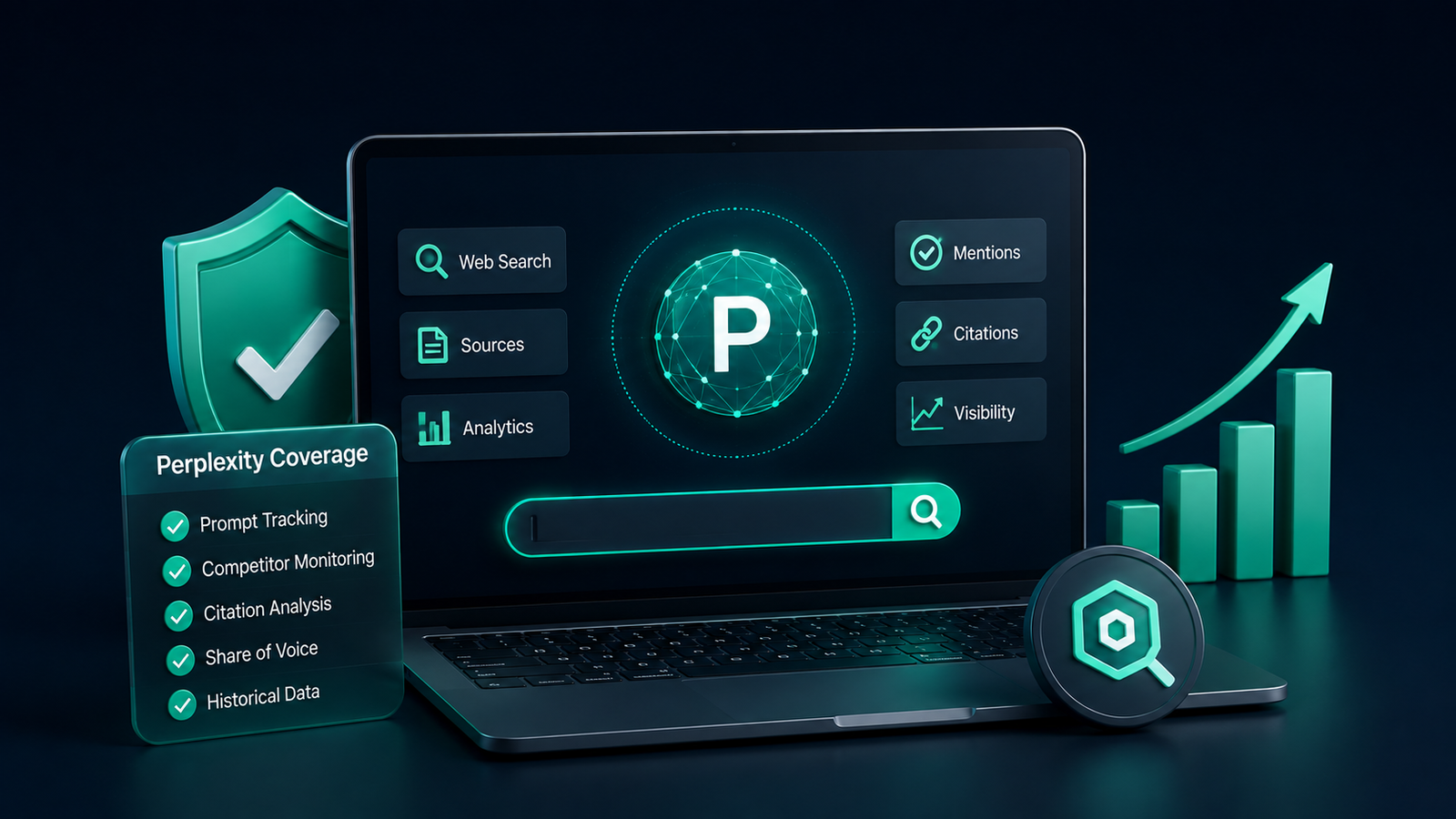
Businesses specifically interested in Perplexity should ask whether a provider actually monitors Perplexity prompts and citations or simply lists the platform as a supported channel.
A useful service should explain how it measures brand mentions, citations, competitors, prompt performance, and changes over time. It should also place Perplexity within a broader strategy because visibility in one AI system does not automatically transfer to another.
The same principle applies to services marketed as the best AI search optimization service with Perplexity coverage: evaluate the methodology, monitoring depth, reporting, and evidence rather than relying on the word “best” in a provider’s marketing copy.
How to Measure AI Search Optimization Results
AI visibility should not be measured in isolation. A useful reporting system can combine AI-specific signals with traditional SEO and business outcomes.
- AI brand mentions
- Website citations
- Visibility across monitored prompts
- Competitor share of voice
- Organic impressions
- Organic traffic
- Conversions and leads
- Branded search trends
- Referral traffic from AI platforms where available
Google’s new generative-AI Search Console reports provide visibility data for generative AI features such as AI Overviews and AI Mode. The initial reporting includes information such as impressions, pages, countries, devices, and dates, with the rollout initially limited to a subset of websites.
Results should be evaluated over weeks or months rather than from a single AI response because generated answers can change.
Common Mistakes to Avoid
- Keyword stuffing: Repeating a phrase unnaturally does not create useful topical coverage.
- Mass-producing low-value pages: Creating large volumes of similar content primarily to gain rankings can create spam-policy problems.
- AI ranking guarantees: No legitimate provider can guarantee that a particular AI platform will cite a specific page.
- Ignoring technical SEO: Content cannot perform properly if important pages cannot be crawled or indexed.
- Buying artificial links: Low-quality link campaigns can create risk without building genuine authority.
- Tracking irrelevant prompts: More data is not necessarily better data.
- Optimizing for machines instead of readers: Content should remain useful even when no AI system is involved.
- Ignoring competitors: Knowing which brands and sources appear in relevant answers helps identify content and authority gaps.
Google’s Search spam policies specifically address practices such as keyword stuffing, link spam, doorway abuse, and scaled content abuse. Reviewing these policies before publishing large volumes of AI-assisted content is a sensible precaution.
Frequently Asked Questions
What are AI search optimization services?
They are services designed to improve how a business’s website and information are understood and potentially referenced across AI-powered search experiences while maintaining strong traditional SEO foundations.
Does AI search optimization replace traditional SEO?
No. AI search optimization builds on technical SEO, useful content, internal linking, authority, and other established SEO practices.
How can I optimize my website for AI search?
Focus on original and useful content, clear answers, topical depth, accurate business information, strong internal linking, technical accessibility, and ongoing monitoring.
Can a company guarantee ChatGPT or Google AI Mode visibility?
No. AI systems use changing retrieval and ranking processes, so no responsible provider can guarantee that a particular page will appear in a specific generated answer.
What is the difference between AI SEO and traditional SEO?
Traditional SEO focuses heavily on visibility in ranked search results, while AI search optimization also considers mentions, citations, source selection, and visibility within generated answers.
Are AI search optimization services worth using?
They can be useful for businesses whose audiences increasingly use AI-powered search, provided the work is based on measurable improvements rather than unsupported ranking promises.
Conclusion
AI search optimization services are best understood as an extension of modern SEO. Businesses do not need to abandon traditional search strategies to participate in AI search. Instead, they should build on the fundamentals that already make a website useful: original information, clear explanations, strong topical coverage, technical accessibility, credible authority, and a good experience for visitors.
The most sustainable strategy is not to chase a secret AI ranking formula or repeat keywords until a page appears relevant. It is to create information that genuinely deserves to be discovered and referenced.
As AI search continues to evolve, businesses can use tools, analytics, and visibility monitoring to understand where opportunities are emerging while continuing to measure the outcomes that matter most: qualified traffic, leads, conversions, and useful visibility.

- How to Add Captions to Short Videos That People Actually Read - October 8, 2026
- 10 Step AI Search Content Optimization Checklist - October 6, 2026
- Competitor Visibility Tracker: How to Monitor Search and AI Visibility - August 22, 2026









Pingback: 10 Step AI Search Content Optimization Checklist: Easy Guide
Pingback: How To Get Cited By ChatGPT In 2026: Best Playbook