
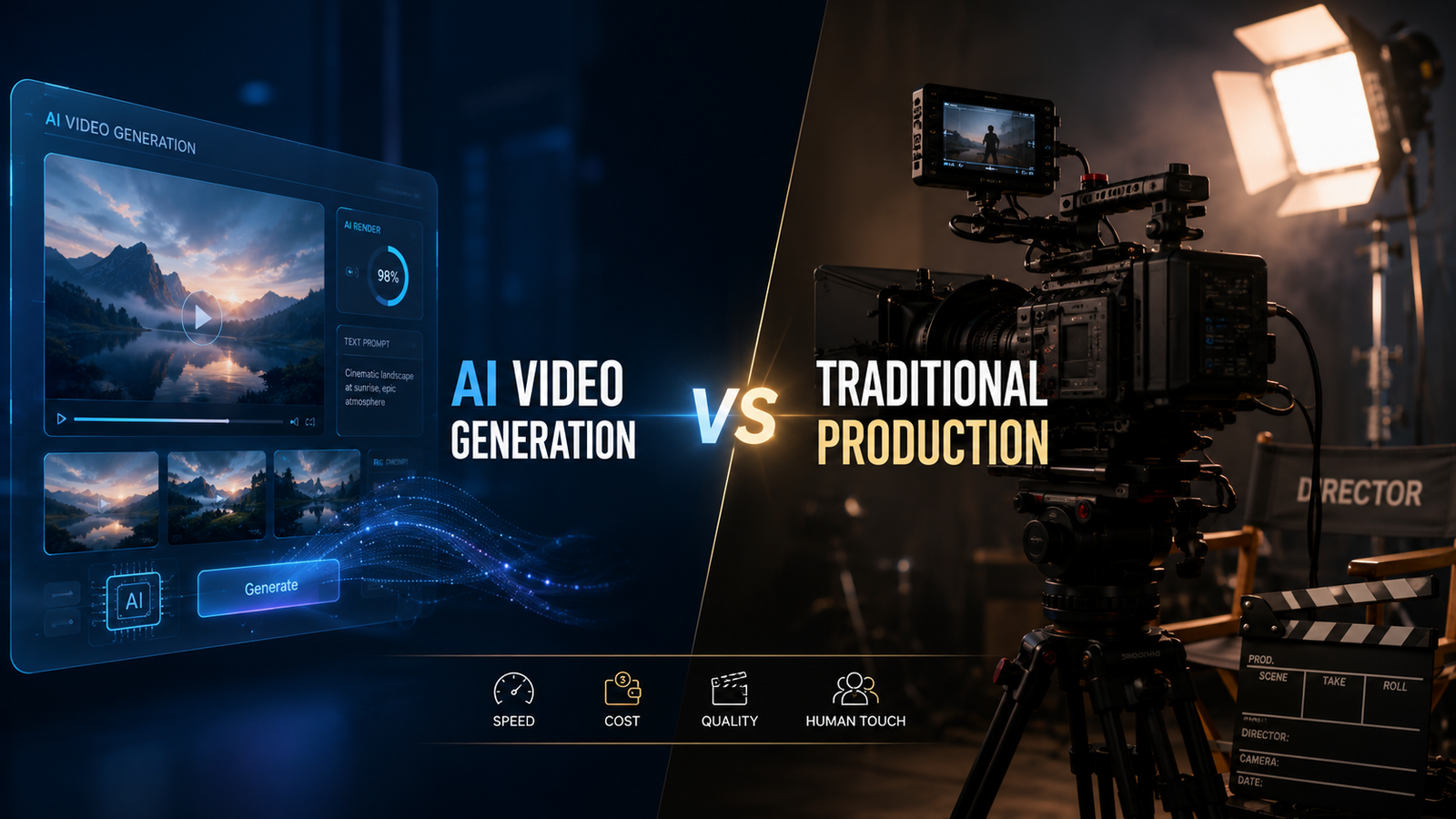
AI Video Generation vs Traditional Video Production in 2026
AI video generation vs traditional video production is one of the most debated topics reshaping the content industry in 2026. As generative AI tools become increasingly sophisticated, creators, marketers, and production studios are being forced to make a fundamental choice: invest in conventional filmmaking workflows or embrace AI-powered video creation. The answer isn’t always obvious and for most professionals, it depends heavily on goals, budgets, and the type of content being produced. This article breaks down both approaches with precision so you can make an informed decision.
Understanding the Core Difference: AI Video Generation vs Traditional Methods
At its foundation, the debate around ai video generation vs traditional production comes down to how content is created, how long it takes, and what resources it demands. Traditional video production relies on physical cameras, lighting rigs, professional crews, location scouting, actors or presenters, post-production editing, and color grading — all coordinated across days or weeks. AI video generation, by contrast, uses machine learning models to synthesize video content from text prompts, images, or minimal input data, compressing what once took weeks into hours or even minutes.
This isn’t a subtle difference. It’s a complete paradigm shift in how moving image content gets made.
The Speed and Cost Advantage of AI Video Generation
One of the most compelling arguments in the ai video generation vs traditional debate is the sheer difference in production speed and cost efficiency. A professionally produced 60-second brand video using traditional methods can easily cost $5,000 to $50,000 when you factor in crew, equipment rental, talent fees, studio time, and post-production. Turnaround time often runs two to four weeks.
AI video generation platforms can produce comparable visual outputs for a fraction of that cost — often under $100 per video — with turnaround measured in minutes. For high-volume content needs like social media campaigns, product demos, or localized ad variations, this advantage is enormous. Tools like OpenAI’s Sora and other generative video platforms have demonstrated that cinematic-quality motion content can now be produced without a single camera on set.
Where Traditional Video Production Still Wins
Despite the efficiency gains that ai video generation vs traditional comparisons often highlight, conventional production retains irreplaceable advantages in several contexts. Live events, documentary storytelling, human-to-human emotional narratives, and brand authenticity campaigns still benefit enormously from real-world filming. When a brand needs genuine testimonials, physical product demonstrations, or emotionally resonant storytelling that requires real human presence, traditional production delivers something AI cannot fully replicate at least not yet.
There’s also the matter of trust. Audiences in 2026 are increasingly AI-literate. Certain verticals healthcare, legal services, financial advice require a level of authenticity and verified human identity that AI-generated video cannot credibly provide without risking reputational damage.
Creative Control and Flexibility in Each Approach
When evaluating ai video generation vs traditional workflows from a creative standpoint, both approaches offer distinct advantages. Traditional production gives directors and cinematographers granular control over every visual element — lens choice, lighting ratios, blocking, performance nuance, ambient sound design. That level of intentional craft is why high-end commercial and cinematic work still relies on conventional methods.
AI video generation, however, offers a different kind of creative freedom: iteration at speed. A creator can generate 20 visual variations of the same concept in the time it would take a traditional crew to set up a single shot. This makes AI tools exceptionally powerful for:
- Early-stage concept visualization and storyboarding
- Rapid A/B testing of visual styles and messaging
- Producing multilingual video variants without re-shooting
- Creating content at scales that traditional production simply can’t sustain
AI Video Generation vs Traditional: Quality Benchmarks in 2026
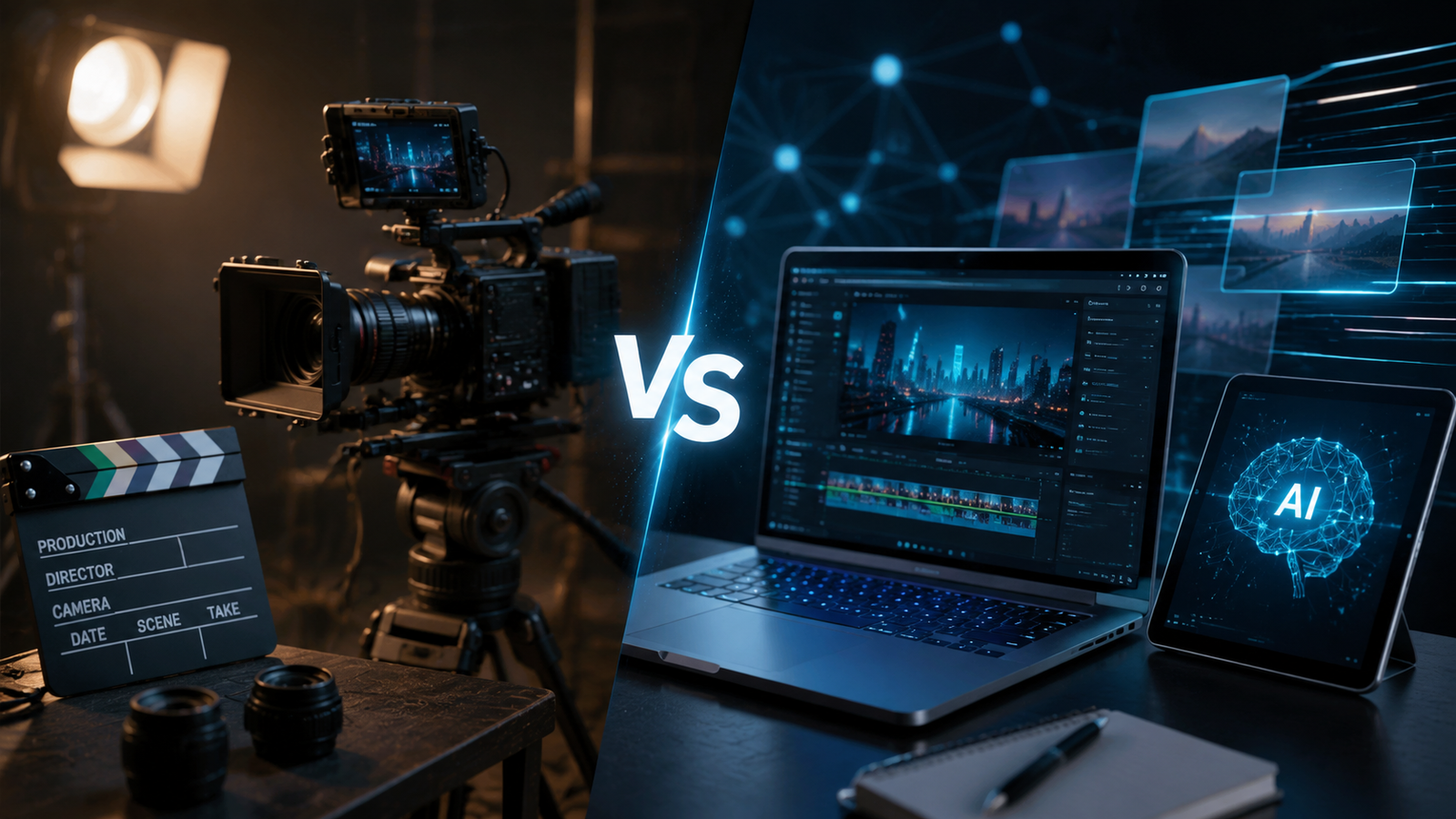
The quality gap between AI-generated and traditionally produced video has narrowed dramatically. As recently as 2023, AI video suffered from obvious visual artifacts, inconsistent motion, and unrealistic physics. By 2026, leading generative models produce output that is indistinguishable from live footage in many scenarios particularly for short-form social content, explainer videos, and marketing materials.
That said, long-form narrative content, complex multi-actor scenes, and projects requiring precise brand identity consistency still expose the limitations of current AI systems. Adobe Research has published studies showing that human viewers still detect AI-generated motion inconsistencies at higher rates in longer video formats, suggesting that quality parity at scale remains a near-future milestone rather than a present reality.
SEO and Content Marketing Implications
From a content marketing and SEO perspective, the ai video generation vs traditional question has direct implications for publishing velocity and search visibility. Google’s video indexing systems in 2026 reward consistent, high-quality video content across YouTube, Google Discover, and embedded page experiences. AI-generated video enables content teams to publish at frequencies that traditional production budgets simply cannot support.
For brands targeting competitive video SERPs, the ability to produce weekly or even daily video content optimized with structured metadata, transcripts, and schema markup — is a significant ranking advantage. This is especially relevant for teams exploring AI-powered content tools, which you can discover across this curated AI tools resource covering the latest generation of visual AI applications.
Ethical Considerations and Disclosure Standards
The ai video generation vs traditional debate also carries ethical weight that creators and brands cannot ignore. In 2026, the FTC and multiple international regulatory bodies have implemented disclosure requirements for AI-generated video content used in advertising. Misleading audiences with synthetic media — particularly deepfake-adjacent content featuring real individuals — carries significant legal risk.
Responsible brands are building AI disclosure frameworks into their content pipelines, labeling AI-generated video transparently and using it in contexts where synthetic origin doesn’t create audience deception. This ethical dimension is a factor traditional production has never had to navigate, and it represents a genuine operational consideration when choosing between the two approaches.
- Always disclose AI-generated content in commercial and political contexts
- Avoid using AI video to simulate real people without explicit consent
- Review platform-specific policies — YouTube, Meta, and TikTok all have AI content labeling requirements in 2026
Hybrid Production: The Most Practical Path Forward
The most sophisticated creators in 2026 aren’t choosing sides in the ai video generation vs traditional debate — they’re blending both. Hybrid production workflows use traditional filming for hero content (brand films, flagship campaigns, executive interviews) and AI generation for derivative content, social adaptations, and localized variants. This approach maximizes both quality and volume while keeping production costs manageable.
According to reporting from Variety, major studios and advertising agencies are actively restructuring production pipelines to integrate AI tools at the pre-production and post-production stages, while preserving human-led shooting for primary content. The future of professional video isn’t AI or traditional — it’s AI-augmented traditional production.
Closing Perspective
The ai video generation vs traditional production debate reflects a broader transformation in how creative work gets done in the age of intelligent machines. Neither approach is universally superior — both have contexts where they excel, limitations that matter, and tradeoffs that must be weighed against specific creative and commercial goals. What’s clear in 2026 is that creators who understand both methodologies, and who know when to apply each, will hold a decisive competitive advantage. AI video generation has permanently altered the economics and speed of content production. Traditional methods retain their supremacy where human authenticity, narrative depth, and brand trust are non-negotiable. The winning strategy is knowing exactly which tool to reach for and when.
Reader Queries
Is AI-generated video good enough to replace traditional production entirely?
For most short-form, high-volume, and marketing-focused content, AI video generation in 2026 is genuinely production-ready. However, for long-form storytelling, premium brand films, and content requiring real human presence, traditional production still delivers results that AI cannot fully match.
How does AI video generation affect SEO and search rankings?
AI video generation allows content teams to produce and publish video at much higher frequencies, which directly supports video SEO strategies. Google rewards consistent video publishing with structured metadata and transcripts something AI tools make significantly more scalable than traditional workflows.
What are the legal risks of using AI-generated video for advertising?
In 2026, multiple regulatory frameworks require disclosure of AI-generated video in commercial and political advertising. Brands using synthetic media featuring real individuals without consent face serious legal and reputational exposure. Always consult platform policies and local regulations before publishing AI video content commercially.
Which industries benefit most from AI video generation?
E-commerce, digital marketing, SaaS companies, online education, and social media content creators benefit most. These sectors require high-volume, fast-turnaround visual content where AI’s speed and cost advantages are most impactful relative to traditional production.
Can AI video generation maintain consistent brand identity?
Brand consistency remains one of the more challenging aspects of AI video generation. While tools have improved significantly, maintaining precise color palettes, spokesperson appearances, and tonal consistency across large volumes of AI-generated content still requires careful prompt engineering and human quality review.

- How to Add Captions to Short Videos That People Actually Read - October 8, 2026
- 10 Step AI Search Content Optimization Checklist - October 6, 2026
- Competitor Visibility Tracker: How to Monitor Search and AI Visibility - August 22, 2026