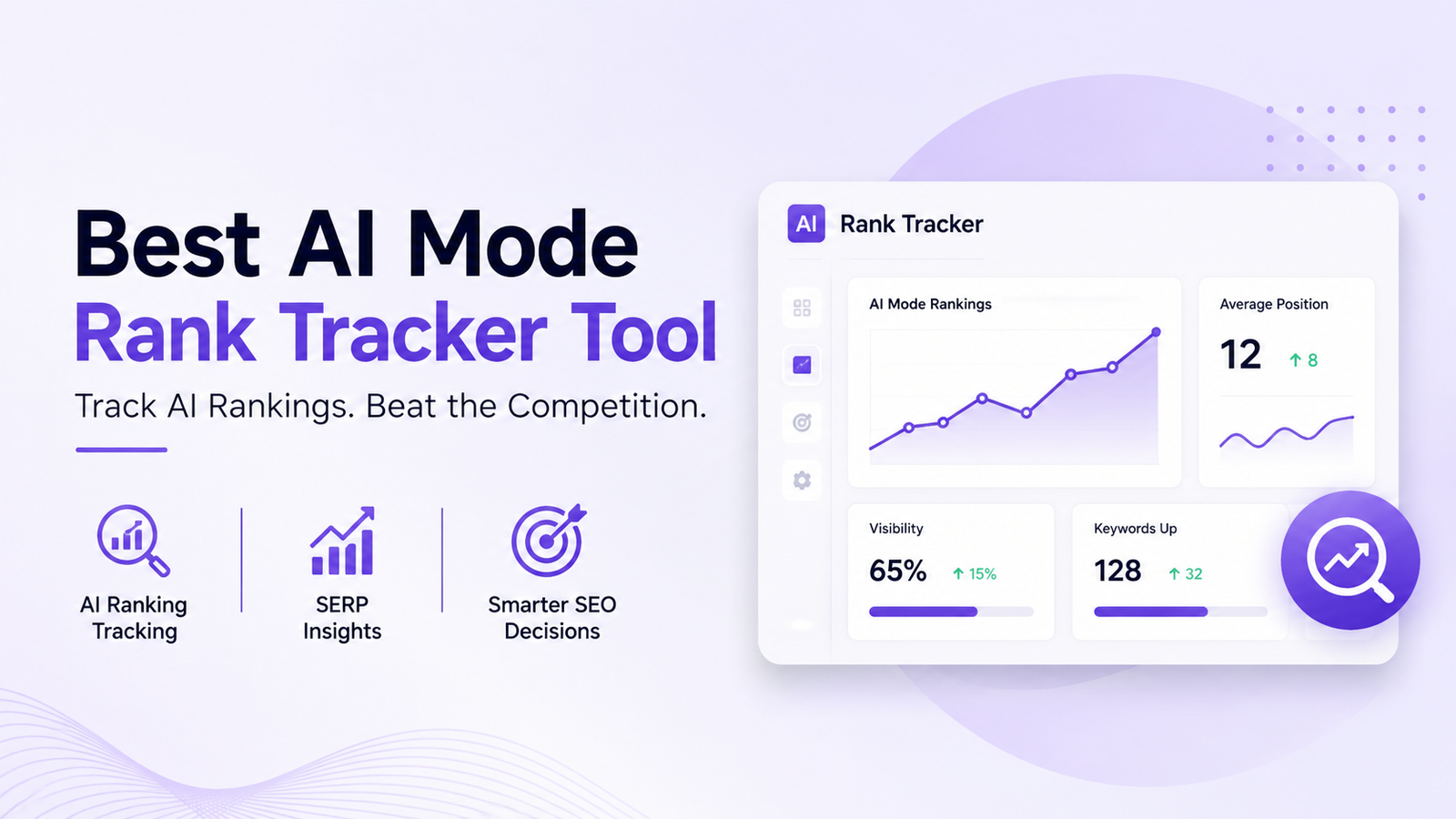
Best AI Mode Rank Tracker Tool: Top 4 Compared for 2026
Google Search is becoming more conversational and increasingly influenced by AI. With Google AI Mode, users can ask complex questions, continue with follow-up questions, and explore information gathered from multiple searches and web sources.
For SEO professionals, this creates a new measurement challenge. Traditional rank tracking still matters, but it is no longer the only way to understand search visibility.
That is why businesses are looking for the best AI Mode rank tracker tool to monitor AI search visibility, keywords, competitors, mentions, citations, and changes over time.
In this guide, we explain what AI Mode tracking means, which features matter, how the leading tools compare, and how to build a practical AI search tracking workflow using both dedicated SEO software and Google Search Console.
What Is an AI Mode Rank Tracker?
An AI Mode rank tracker is a tool that helps monitor how a website, brand, or content appears in AI-powered search experiences such as Google AI Mode.
There is an important difference between traditional rank tracking and AI search tracking.
A traditional rank tracker usually reports where a page appears for a keyword in conventional search results. AI search is more dynamic. Depending on the platform, the same question can produce different answers, sources, mentions, and citations.
Google describes AI Mode as an AI-powered Search experience that can break a question into subtopics and search for those topics simultaneously before producing a response with relevant web links.
Because of this, modern AI search tracking often focuses on measurements such as:
- AI search visibility
- Brand mentions
- Page and domain citations
- Competitor visibility
- Share of voice
- Tracked prompts and queries
- Changes in visibility over time
For traditional SEO rankings, you should continue using a conventional rank tracker alongside AI search monitoring.
For more information about the related ChatGPT ecosystem, see our guide to ChatGPT site rank tracking software.
Why AI Mode Rank Tracking Matters for SEO
AI-powered search changes how users discover information. Instead of simply receiving a list of blue links, users can receive an AI-generated response that combines information from several sources and provides links for further exploration.
This creates new questions for SEO teams:
- Is my website visible when users ask important questions?
- Which pages are being cited?
- Which competitors appear more frequently?
- Which topics generate visibility for my brand?
- Which queries represent opportunities for new or improved content?
- Is my traditional organic visibility supported by AI search visibility?
Tracking these signals can help you identify opportunities that may not be obvious from traditional keyword positions alone.
AI search visibility should therefore complement traditional SEO rather than replace it.
AI Mode vs Traditional Google Rankings
One of the most important things to understand before choosing an AI Mode rank tracker is that AI Mode should not be treated exactly like a traditional SERP.
| Traditional SEO tracking | AI search tracking |
|---|---|
| Keyword position | AI visibility |
| Organic ranking | Mentions and citations |
| SERP competitors | AI search competitors |
| Clicks and impressions | Visibility and share of voice |
| Stable keyword-based reporting | Dynamic prompt and response monitoring |
This distinction matters because AI responses can change between searches. A good AI search tracking platform therefore gives you a repeatable way to monitor visibility rather than pretending that every AI response behaves like a fixed ten-result SERP.
What Makes the Best AI Mode Rank Tracker Tool?
The best AI Mode rank tracking tool is not necessarily the software with the largest number of features. The right platform should give you reliable information that helps you improve your SEO strategy.
When comparing AI Mode tracking software, pay attention to the following capabilities.
AI Mode Visibility Tracking
The tool should provide a practical way to monitor whether your brand or website appears in supported AI search experiences.
This is more useful than simply checking one AI response manually because you can monitor a defined set of queries or prompts over time.
Keyword and Prompt Tracking
Look for tools that allow you to monitor important keywords and longer, question-based prompts.
For example, an ecommerce business could track both a keyword such as “best wireless keyboard” and a longer question such as “what is the best wireless keyboard for working from home?”
Brand Mention Monitoring
AI search visibility is not limited to links. Your brand may be mentioned even when a user does not click through to your website.
Brand mention tracking can therefore provide another way to measure how often your business appears in AI-generated answers.
Page and Domain Citations
Some AI visibility platforms can show which pages or domains are cited in AI responses. This can help you identify which content is already earning visibility and which competitors are being cited instead.
Competitor Tracking
Competitor comparison is particularly useful when you want to understand why another company appears in AI answers while your brand does not.
Historical Monitoring
AI search results can change. Historical reporting helps you determine whether your visibility is improving, declining, or fluctuating.
Custom Prompts
Custom prompt tracking is useful when your business depends on specific questions that may not be represented accurately by short keywords.
Reports and Alerts
Automated reporting can save time for agencies and SEO teams. Alerts can also help you notice important changes without manually checking every query.
Best AI Mode Rank Tracker Tools in 2026
There is no single AI Mode rank tracker that is best for every website. Different tools use different datasets, tracking methods, and reporting systems.
| Tool | Best suited for | Key strength |
|---|---|---|
| SE Ranking | SEO teams and growing websites | Traditional rank tracking combined with AI search monitoring |
| Semrush | Agencies and larger SEO campaigns | AI visibility, competitor research, keywords, and reporting |
| Ahrefs | Content and SEO research | AI visibility, citations, competitors, keywords, and backlinks |
| Google Search Console | Beginners and website owners | First-party Google Search performance data |
SE Ranking
SE Ranking is worth considering if you want traditional SEO tracking alongside AI search monitoring.
Its AI Search functionality includes tracking for AI search experiences and can be used alongside conventional keyword rank tracking. This makes it particularly interesting for websites that want to keep their traditional SEO workflow and AI search monitoring within one platform.
For beginners, the advantage is simplicity: you can monitor conventional SEO metrics while gradually adding AI search visibility to your workflow.
Always check the current plan details and AI search tracking limits before purchasing because features and pricing can change.
Semrush
Semrush offers AI visibility features that can track brand visibility across Google AI Mode, AI Overviews, ChatGPT, Gemini, and other supported AI platforms.
Its documentation describes tracking for custom keywords and prompts, competitor benchmarking, mentions, citations, and AI visibility.
Semrush can be a good choice for agencies and larger SEO campaigns that already use the platform for keyword research, competitor analysis, and reporting.
Ahrefs
Ahrefs takes a slightly different approach to AI search measurement.
Its Brand Radar product focuses on AI visibility metrics such as mentions, citations, impressions, and AI Share of Voice across supported AI platforms.
Ahrefs also provides a dedicated Google AI Mode tracker for checking how brands appear in AI Mode and which pages are cited.
This approach is useful because AI search does not always behave like a conventional ranking system. Instead of focusing only on a fixed position, you can analyze visibility and competitive presence across a larger set of AI responses.
Google Search Console
Google Search Console should remain part of your SEO measurement system even if you purchase a dedicated AI search tracking platform.
Search Console provides first-party Google Search performance data, including queries, clicks, impressions, CTR, and average position.
It is particularly useful for discovering queries that Google already associates with your pages.
For example, if a page receives hundreds of impressions for AI Mode-related searches while averaging around position 15 to 20, that page may be a strong candidate for content improvement.
How to Choose the Best AI Mode Rank Tracker for Your Website
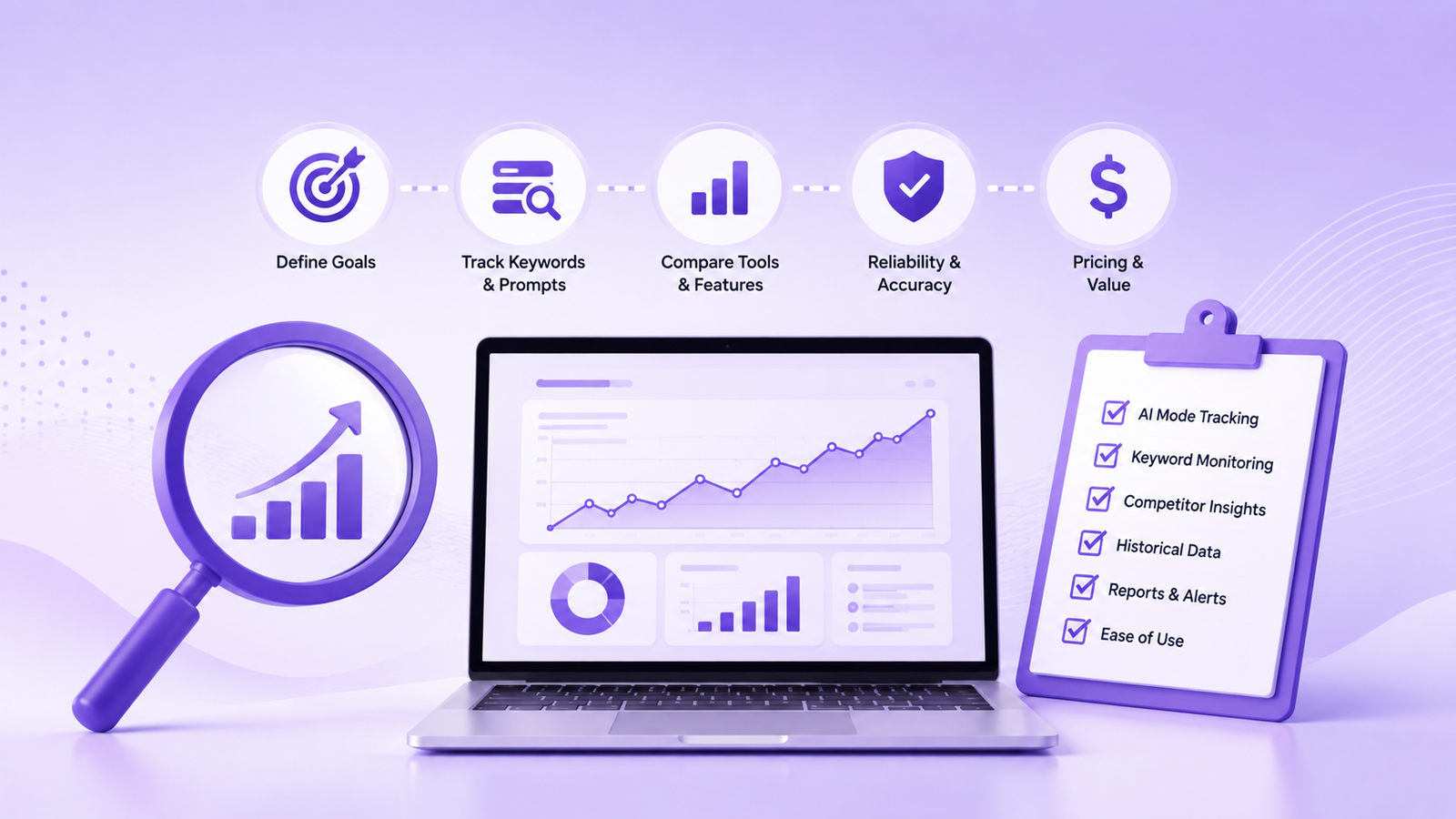
Before purchasing a tool, consider your actual requirements instead of choosing the platform with the longest feature list.
- How many keywords and prompts do you need to track?
- Do you specifically need Google AI Mode monitoring?
- Do you want ChatGPT, Gemini, Perplexity, or other AI platforms tracked as well?
- Do you need competitor comparison?
- Do you need historical visibility data?
- Do you need custom prompts?
- Will you need scheduled reports?
- How many users need access?
- Does the tool fit your SEO budget?
A small website may be able to start with Google Search Console and manual analysis. A larger website or agency may benefit from automated tracking and competitive reporting.
How to Track AI Mode Keywords Effectively
Do not begin by adding hundreds of unrelated keywords to your tracking system.
Start with queries that are already relevant to your website and business.
Use Google Search Console to Find Opportunities
Open the Performance report in Search Console and identify pages receiving meaningful impressions for relevant queries.
Pay particular attention to queries where:
- The page is already receiving impressions.
- The average position is between approximately 11 and 30.
- The query is closely related to the page.
- The search intent matches the content.
- The query represents useful traffic or business value.
These pages are often better optimization candidates than pages with almost no impressions.
Build AI Mode Keyword Clusters
Group similar queries into topic clusters instead of treating every keyword variation as a completely separate subject.
For example, your AI Mode rank tracking cluster could include:
- best AI Mode rank tracker
- best AI Mode rank tracker tool
- best AI Mode rank tracking tools
- AI Mode rank tracking tool
- AI Mode rank tracking software
- AI Mode keyword rank tracker
- online AI Mode rank tracker
The goal is not to repeat these phrases throughout the article. The goal is to make the page genuinely useful for the broader topic represented by the cluster.
How to Use an AI Mode Rank Tracker With Google Search Console
Using both systems can give you a more complete SEO workflow.
Search Console shows you actual Google Search performance for your website. A dedicated AI search platform can provide additional monitoring of AI visibility, mentions, citations, competitors, or prompts depending on the tool.
A practical workflow is:
- Export relevant queries from Google Search Console.
- Remove unrelated queries and obvious search noise.
- Group similar queries by search intent.
- Identify pages with strong impressions and weak rankings.
- Add the most important queries or prompts to your tracking platform.
- Monitor visibility over time.
- Improve pages where the content does not fully satisfy the search intent.
- Review the results again after Google has had enough time to recrawl and reassess the page.
This approach is more useful than blindly adding every Search Console query to an AI rank tracker.
How to Improve Your AI Search Visibility
Tracking visibility is only valuable when the data leads to better content.
If a page receives meaningful impressions but remains around positions 15 to 20, review the page before creating a completely new article.
Look for opportunities to improve:
- Search intent alignment
- Content depth
- Clear definitions
- Direct answers to common questions
- Useful examples
- Original analysis
- Accurate and current information
- Logical H2 and H3 structure
- Relevant internal links
- Helpful external references
- Title and meta description
Do not add a keyword simply because it appears in Search Console. The keyword should make sense within the page and represent a topic the page can genuinely answer.
AI Search Visibility Depends on More Than Keywords
AI search visibility is broader than traditional keyword optimization.
AI platforms can use information from many sources when constructing answers. This means your website’s overall authority, content quality, topical coverage, brand mentions, and the usefulness of individual pages can all matter to your broader AI search strategy.
For this reason, publishing several thin articles that target slightly different versions of the same keyword is usually less useful than building a strong topical cluster with genuinely helpful pages.
For example, if you publish several articles about AI Mode rank tracking, connect them with relevant internal links and give each page a distinct purpose.
Common AI Rank Tracking Mistakes
Treating AI Search Like a Normal SERP
AI search does not always provide a stable list of positions. Focus on visibility, mentions, citations, and trends where appropriate.
Tracking Too Many Keywords
Large keyword lists can create noise. Start with the queries that have clear relevance and business value.
Ignoring Search Intent
Similar keywords can have different intentions. Make sure the page actually answers the question behind the query.
Changing a Page Too Frequently
If you make major changes every few days, it becomes difficult to determine which change affected performance.
Make meaningful updates, allow Google time to process them, and then compare the results.
Relying Only on Average Position
Average position should be reviewed alongside impressions, clicks, CTR, queries, and the actual content of the page.
Assuming AI Visibility Guarantees Traffic
A mention or citation in an AI response does not automatically result in a website visit. AI visibility and organic traffic are related but different measurements.
Free AI Mode Rank Tracking Options
If you are a beginner, you do not necessarily need paid AI search software immediately.
Google Search Console is a useful starting point for understanding your website’s performance in Google Search.
You can create a simple tracking sheet with:
- Target query
- Page URL
- Impressions
- Clicks
- CTR
- Average position
- Date checked
- Date of content update
This simple process can teach you how search performance changes before you invest in a dedicated AI search platform.
Some commercial SEO platforms also provide free or limited AI visibility features — for example, free AI Mode visibility checkers exist, though availability and limits change often, so check current offerings before relying on them.
Best AI Mode Rank Tracker for Different Users
| User type | Recommended approach |
|---|---|
| Beginner | Start with Google Search Console and learn your existing query data. |
| Small website | Use Search Console plus a dedicated tracker when manual monitoring becomes difficult. |
| SEO agency | Prioritize competitor tracking, reporting, custom prompts, and scalable keyword monitoring. |
| Enterprise SEO team | Look for large tracking limits, historical data, integrations, APIs, reporting, and multi-platform AI visibility. |
How AI Mode Tracking Fits Into a Modern SEO Strategy
AI Mode tracking should be one part of a broader SEO measurement system.
A practical strategy can combine:
- Google Search Console for first-party Search performance
- Traditional rank tracking for organic keyword positions
- AI Mode tracking for AI search visibility
- Competitor analysis for content gaps
- Content optimization based on real search queries
- Internal linking between related pages
- Brand and citation monitoring where appropriate
If your website also targets ChatGPT visibility, see our guide to the best tools for monitoring ChatGPT mentions.
You can also explore our AI search visibility tools for businesses guide for a broader look at this growing category.
Frequently Asked Questions
What is the best AI Mode rank tracker tool?
There is no single tool that is best for every website. SE Ranking, Semrush, and Ahrefs all provide AI search visibility capabilities, but their approaches and features differ. The best choice depends on whether you need AI Mode monitoring, competitor research, traditional rank tracking, custom prompts, reporting, or broader SEO features.
Can I track Google AI Mode visibility?
Yes. Several third-party SEO platforms now provide AI Mode visibility tracking. These tools generally focus on metrics such as mentions, citations, visibility, prompts, or share of voice rather than treating AI Mode as a conventional ten-result ranking page.
What keywords should I track in AI Mode?
Start with queries that are already relevant to your business. Use Google Search Console to identify queries generating impressions, then group them by topic and search intent. Add the most important commercial, informational, branded, and long-tail questions to your tracking system.
Is there a free AI Mode rank tracker?
Google Search Console is a free starting point for measuring Google Search performance. It does not provide a complete dedicated AI Mode visibility report, but it can help you discover valuable queries and pages. Some third-party platforms also provide limited free AI visibility checking features.
What is the difference between an AI Mode rank tracker and a traditional rank tracker?
A traditional rank tracker primarily measures conventional organic search positions. AI Mode tracking focuses more on whether your brand, website, or pages appear in AI-generated answers, including visibility, mentions, citations, and competitive presence.
How often should I check AI Mode visibility?
Weekly monitoring is a practical starting point for most websites. If you operate in a highly competitive or rapidly changing market, you may want more frequent monitoring. The important thing is to compare trends over time instead of reacting to every individual result.
Can AI Mode tracking replace Google Search Console?
No. Google Search Console and AI search tracking tools serve different purposes. Search Console provides first-party data about your website’s performance in Google Search, while dedicated AI search tools provide additional visibility and competitive monitoring capabilities.
Your Next Step: Picking the Right Tracker
The best AI Mode rank tracker is not simply the tool with the most features. It is the platform that provides data you can actually use to improve your search visibility.
For beginners, Google Search Console is an excellent starting point. As your website grows, tools such as SE Ranking, Semrush, or Ahrefs can add broader keyword monitoring, competitor research, AI visibility tracking, reporting, and other SEO capabilities.
The most practical approach is to build a repeatable system:
- Find relevant queries.
- Group them by topic and search intent.
- Track important keywords and prompts.
- Monitor AI search visibility where supported.
- Improve pages that receive meaningful impressions but have weak visibility.
- Strengthen internal links between closely related pages.
- Measure the results before making another major change.
AI Mode is still evolving, so the best SEO strategy is to monitor real data, avoid unsupported assumptions, and improve content based on the search behavior and visibility signals you can actually measure.
For TechlsPro readers, the key takeaway is simple: use traditional SEO tracking to understand your organic rankings, and use AI search visibility tracking to understand how your website and brand are appearing in the new generation of search experiences.

- How to Add Captions to Short Videos That People Actually Read - October 8, 2026
- 10 Step AI Search Content Optimization Checklist - October 6, 2026
- Competitor Visibility Tracker: How to Monitor Search and AI Visibility - August 22, 2026