AI Mode Rank Tracking Software: 10 Best Tools for Visibility Tracking in 2026
AI search is changing how people discover businesses, products, and information. As Google AI Mode, ChatGPT, AI Overviews, Gemini, and other conversational search experiences become more important, traditional keyword rankings no longer provide the complete picture. AI Mode Rank Tracking Software helps SEO teams monitor how brands and websites appear in AI-generated answers, citations, and recommendations.
In this guide, we compare 10 AI visibility and rank tracking tools, explain what to look for when choosing one, and show how free and paid options differ. The goal is to help you choose the right AI Mode Rank Tracking Tool without creating a separate workflow for every AI search platform.
Why AI Mode Tracking Matters for SEO
Traditional SEO still matters, but AI-powered search introduces another layer of visibility. A page can rank well in conventional search results while receiving little or no exposure inside an AI-generated answer.
An effective AI tracking workflow can help you understand:
- Whether your brand appears in AI-generated answers.
- Whether your website is cited or linked as a source.
- Where your brand appears compared with competitors.
- Which prompts and topics generate the most visibility.
- How your AI visibility changes over time.
- Which pages are repeatedly used as sources.
- Where content gaps may be limiting your visibility.
This is why AI Mode Rank Tracking Software should complement, rather than replace, traditional SEO platforms. Google Search Console and conventional rank trackers remain useful for understanding organic search performance, while AI tracking adds visibility data from newer search experiences.
What Is AI Mode Rank Tracking Software?
AI Mode Rank Tracking Software is software designed to monitor how a website, brand, product, or competitor appears within AI-powered search experiences. Depending on the platform, this may include Google AI Mode, Google AI Overviews, ChatGPT, Gemini, Perplexity, and other AI systems.
Instead of measuring only a traditional SERP position, AI tracking can examine metrics such as mentions, citations, links, visibility, position within an AI response, competitors, and changes over time.
Because AI responses can change based on prompts, models, locations, and other conditions, AI rankings are best treated as a visibility signal rather than an exact replacement for conventional Google rankings.
Free vs Paid AI Mode Rank Tracking Tools
If you are looking for free AI Mode rank tracking tools, the good news is that several platforms offer free tiers or trials. These can be useful when you are testing a small number of prompts or learning how AI visibility works, and they may be sufficient for a small website with limited tracking requirements.
Free tools and trials may provide:
- Limited AI visibility checks.
- Basic brand-mention monitoring.
- Manual prompt testing.
- Small numbers of tracked queries.
Paid platforms commonly provide:
- Larger prompt or keyword limits.
- Recurring monitoring.
- Competitor benchmarking.
- Historical visibility data.
- Exportable reports.
- Multiple projects or brands.
- Team and client reporting features.
Paid platforms become more useful when you need larger prompt sets, recurring monitoring, competitor comparisons, historical reporting, multiple projects, or agency-level reporting.
10 Best AI Mode Rank Tracking Tools to Consider in 2026
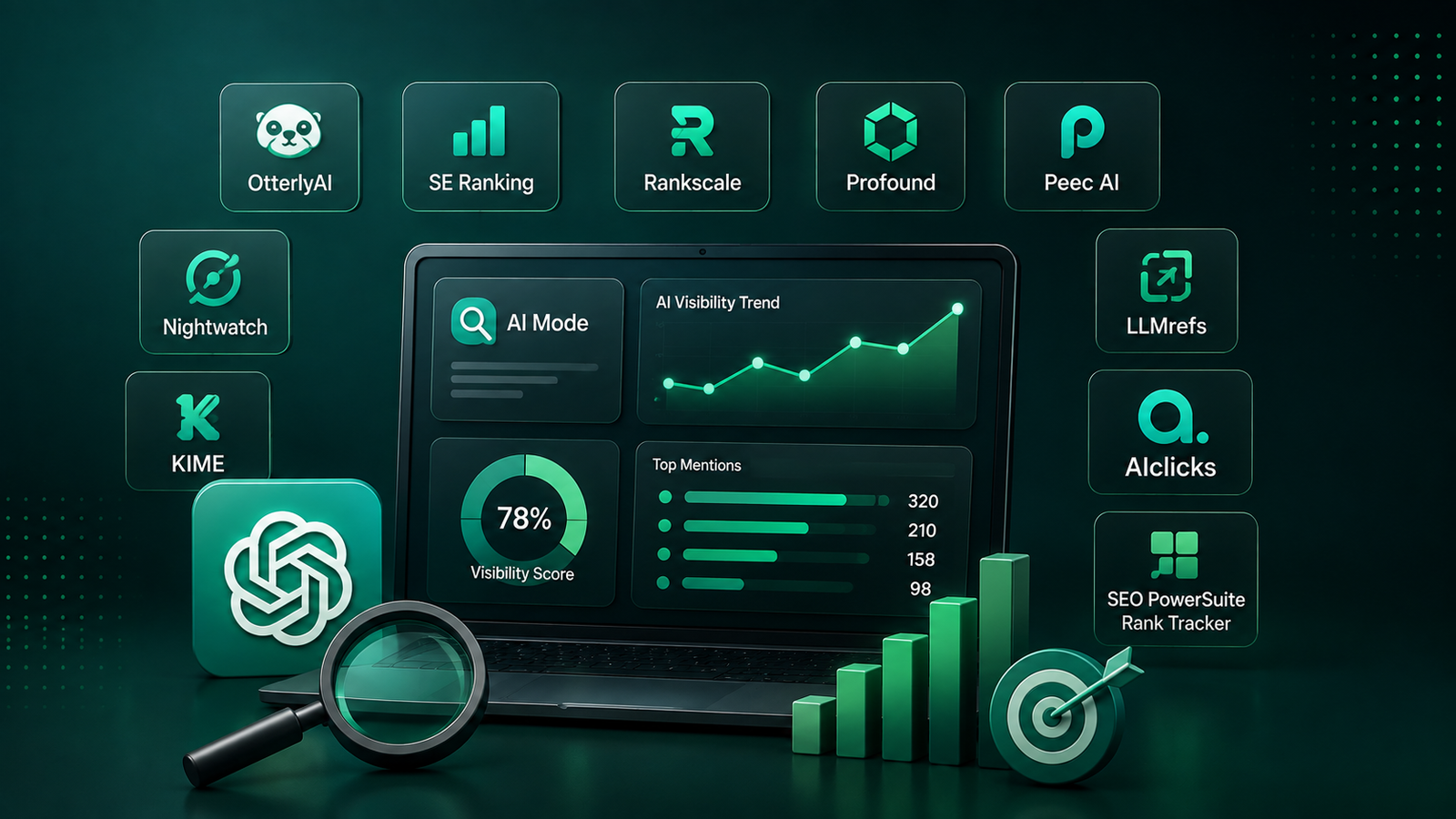
There is no single best platform for every website. Some tools focus heavily on Google AI Mode, while others provide broader AI search visibility across ChatGPT, Gemini, Perplexity, AI Overviews, and additional platforms. If your priority is specifically Google’s AI Mode rather than multi-engine coverage, you may also want to read our guide to the best AI Mode rank tracker tool.
A quick note before the list: AI search tools evolve fast, with features and platform coverage changing frequently. Treat the descriptions below as a starting point and verify current capabilities on each vendor’s website before making a decision.
| Tool | Best For | AI Visibility Focus | Ideal User |
|---|---|---|---|
| OtterlyAI | Multi-engine AI monitoring | AI mentions, citations, AI Mode and other AI search surfaces | SEO teams and agencies |
| SE Ranking | SEO + AI visibility | AI Mode, ChatGPT, AI Overviews, Gemini and Perplexity | Agencies and in-house teams |
| Rankscale | Broad AI visibility tracking | AI rankings, mentions, citations and visibility | Brands and SEO teams |
| Profound | Enterprise AI visibility | AI search monitoring and analytics | Large organizations |
| Peec AI | AI search analytics | Visibility, position, sentiment and share of voice | Marketing teams |
| Nightwatch | SEO and AI tracking | LLM visibility and traditional rankings | SEO professionals |
| LLMrefs | AI search visibility | ChatGPT, AI Mode, AI Overviews and other AI engines | Brands and agencies |
| KIME | Google AI Mode-focused tracking | AI Mode and prompt visibility | Google-focused SEO teams |
| AIclicks | AI visibility monitoring | AI mentions, citations and visibility | Growing businesses |
| SEO PowerSuite Rank Tracker | Traditional rank tracking | Organic rankings and AI-related SERP features | Budget-conscious SEO teams |
1. OtterlyAI
OtterlyAI is an AI search monitoring and optimization platform that tracks brand and website visibility across several AI search experiences. Its coverage has included Google AI Overviews, Google AI Mode, ChatGPT, Perplexity, Gemini, Microsoft Copilot, and Claude.
It can be a strong option if you want one platform for monitoring mentions, citations, prompts, competitors, and AI visibility rather than checking each AI platform manually.
Key strengths
- Broad AI search coverage.
- AI Mode and AI Overview monitoring.
- Brand and domain visibility tracking.
- Prompt research and GEO-oriented features.
Best for: SEO teams, agencies, and marketers who want broad AI search monitoring.
2. SE Ranking
SE Ranking combines traditional SEO functionality with AI visibility tracking. Its AI Results Tracker has covered Google AI Overviews, Google AI Mode, Gemini, ChatGPT, and Perplexity.
This makes SE Ranking particularly interesting for teams that want their traditional SEO and AI visibility workflows in the same broader platform.
Key strengths
- AI Mode tracking.
- ChatGPT visibility tracking.
- AI Overviews monitoring.
- Competitor comparisons.
- Combination of traditional SEO and AI visibility data.
Best for: Agencies and in-house SEO teams that already need a conventional rank tracking platform.
3. Rankscale
Rankscale focuses on AI search visibility and Generative Engine Optimization. Its platform tracks visibility across a broad range of AI engines and includes Google AI Mode alongside ChatGPT, Perplexity, Gemini, Claude, AI Overviews, and other platforms.
Key strengths
- Broad AI engine coverage.
- AI visibility and ranking data.
- Brand and competitor monitoring.
- Citation analysis.
- Historical visibility trends.
Best for: Businesses that want broad AI search monitoring rather than focusing on one AI platform.
4. Profound
Profound is designed around AI search visibility and is particularly relevant to organizations that need structured monitoring and analytics at a larger scale.
Key strengths to evaluate
- AI search visibility monitoring.
- Enterprise-oriented workflows.
- Competitive visibility analysis.
- Reporting for larger teams.
Best for: Larger organizations and teams that need enterprise-level AI search intelligence.
5. Peec AI
Peec AI focuses on AI search analytics and provides metrics such as visibility, position, sentiment, and share of voice. It also lets users identify important prompts, monitor rankings, and compare performance with competitors.
Key strengths
- AI visibility measurement.
- Position tracking.
- Sentiment analysis.
- Share-of-voice reporting.
- Competitor comparison.
Best for: Marketing teams that want easy-to-understand AI search analytics.
6. Nightwatch
Nightwatch combines traditional SEO monitoring with AI and LLM tracking. Its AI tracking features are designed to show whether brands appear in AI responses, how often they appear, their position, sentiment, and which sources AI systems use.
Key strengths
- Traditional rank tracking plus AI tracking.
- Cross-model analysis.
- Brand visibility monitoring.
- Competitor visibility comparisons.
Best for: SEO professionals who want AI tracking alongside conventional rank monitoring.
7. KIME
KIME is relevant for teams specifically interested in Google AI Mode and prompt-level visibility. If Google AI Mode is the primary search surface you want to monitor, a specialized platform can make more sense than a broader AI monitoring solution.
Key strengths to evaluate
- Google AI Mode focus.
- Prompt-level monitoring.
- AI search visibility analysis.
- Useful for Google-focused SEO workflows.
Best for: SEO teams whose main priority is Google AI Mode.
8. LLMrefs
LLMrefs focuses on AI search visibility and tracks brand presence across AI search engines. Its platform has covered ChatGPT, Google AI Mode, Google AI Overviews, Perplexity, Gemini, Claude, Grok, and other AI search environments.
Key strengths
- AI search visibility tracking.
- ChatGPT monitoring.
- Google AI Mode tracking.
- AI Overviews monitoring.
- Share-of-voice and citation analysis.
Best for: Brands, agencies, and SEO teams that want dedicated AI search visibility analytics.
9. AIclicks
AIclicks is a Generative Engine Optimization platform focused on measuring how often brands appear in AI-generated answers. It also connects citations to their sources and provides visibility across several AI systems.
Key strengths
- AI visibility monitoring.
- Brand mention tracking.
- Citation-source analysis.
- Multi-engine coverage.
- GEO-oriented recommendations.
Best for: Businesses that want a dedicated AI visibility and optimization workflow.
10. SEO PowerSuite Rank Tracker
SEO PowerSuite’s Rank Tracker is primarily a traditional SEO ranking and keyword research platform. It can still be useful in an AI-focused SEO stack because it helps monitor conventional rankings and Google SERP features alongside newer AI visibility tools.
SEO PowerSuite has also introduced tracking for Google AI Overviews, allowing users to monitor whether their domain appears within AI-generated search features.
Key strengths
- Traditional keyword rank tracking.
- Keyword research.
- Competitor keyword analysis.
- Ranking reports.
- Google AI Overview monitoring.
Best for: SEO users who want a flexible traditional rank tracker and AI-related SERP monitoring.
How to Choose the Right AI Mode Rank Tracking Tool
The right AI Mode rank tracking software depends on what you actually need to measure. Do not choose a platform simply because it lists the largest number of AI engines.
Instead, consider these seven factors:
- AI platform coverage: Check whether the tool supports the AI surfaces that matter to your audience, such as Google AI Mode, ChatGPT, Gemini, Perplexity, or AI Overviews.
- Prompt tracking: Make sure you can track the questions your potential customers are actually asking.
- Brand and citation monitoring: Look for information about mentions, links, citations, and source URLs.
- Competitor comparison: A useful tool should help you understand which competing brands appear in the same AI responses.
- Historical data: Tracking ChatGPT rankings over time can help you identify whether your visibility is improving, declining, or changing after content updates.
- Reporting: Agencies and larger teams may need exports, dashboards, or scheduled reports.
- Pricing and scale: Compare prompt limits, projects, users, and monitoring frequency rather than looking only at the starting monthly price.
How to Use AI Tracking Data for SEO
Tracking AI visibility is only useful when the data changes what you do next. Start with a small group of important prompts and monitor them consistently.
For example, you can track prompts related to:
- Product comparisons.
- Service recommendations.
- Industry-specific questions.
- “Best” and “top” queries.
- Alternative and comparison searches.
- Questions that directly mention your competitors.
Then compare your AI visibility with your conventional Google performance. If a page performs well organically but rarely appears as an AI citation, investigate its content structure, topical coverage, authority signals, and relevance to the prompt.
AI Tracking Software vs Traditional Rank Tracking
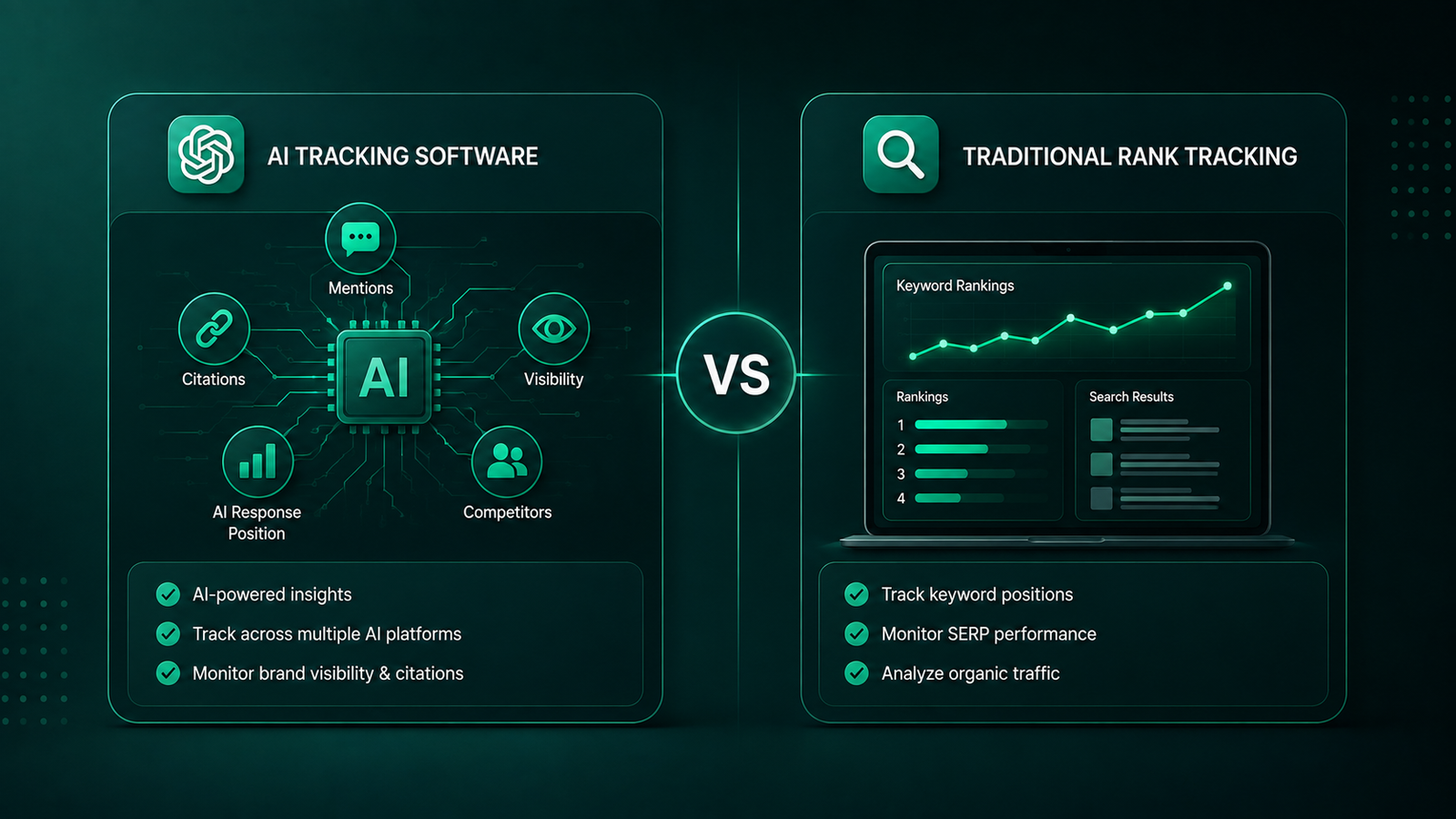
Traditional rank tracking and AI tracking answer different questions.
| Traditional SEO Tracking | AI Search Tracking |
|---|---|
| Keyword position | Brand visibility in AI answers |
| Organic SERP rankings | AI mentions and citations |
| Search-engine positions | AI response position or prominence |
| Keyword movement | Prompt and visibility changes |
| Organic competitors | Brands appearing in AI responses |
The strongest SEO workflow can therefore combine both. Traditional tools remain important for organic search, while AI tracking tools provide another layer of visibility as search behavior evolves.
Common Mistakes When Using AI Mode Rank Tracking Software
- Tracking too many prompts: Start with the questions most closely connected to your business.
- Expecting stable rankings: AI responses can change more frequently than conventional rankings.
- Ignoring citations: A brand mention and a useful website citation are not necessarily the same thing.
- Ignoring competitors: Your visibility is easier to interpret when you know who appears alongside you.
Frequently Asked Questions
Can I do AI Mode rank tracking for free?
Yes, for small-scale needs. Several platforms offer free tiers or trials that cover a limited number of prompts, and you can also manually check how your brand appears in AI Mode for your most important queries. Once you need recurring monitoring, competitor comparisons, or larger prompt sets, a paid plan becomes necessary.
How often should I check my AI visibility?
For most businesses, a weekly or biweekly check is a practical rhythm. AI-generated answers can shift more frequently than traditional rankings, so daily checks usually add noise rather than insight unless you are running an active campaign.
Why do AI rankings fluctuate more than traditional rankings?
AI systems generate answers dynamically based on the prompt, the model version, and available sources, so the same question can produce different results at different times. Treat AI visibility as a trend to monitor over weeks, not a fixed position to defend daily.
What is the difference between AI Mode tracking and AI Overviews tracking?
Google AI Mode is a conversational search experience where users interact with an AI assistant, while AI Overviews are AI-generated summaries shown above traditional search results. Some tools cover both, but if one surface matters more to your audience, prioritize a tool with deeper coverage there.
Final Takeaway
AI Mode rank tracking software has become an essential layer of modern SEO. Start with a clear set of prompts that matter to your business, choose a tool that covers the AI surfaces your audience uses, and review the data regularly enough to spot trends. Combined with traditional rank tracking, it gives you the full picture of how visible your brand really is in 2026.

- How to Add Captions to Short Videos That People Actually Read - October 8, 2026
- 10 Step AI Search Content Optimization Checklist - October 6, 2026
- Competitor Visibility Tracker: How to Monitor Search and AI Visibility - August 22, 2026








Pingback: SEO With AI: 7 Foundational Elements That Matter In 2026