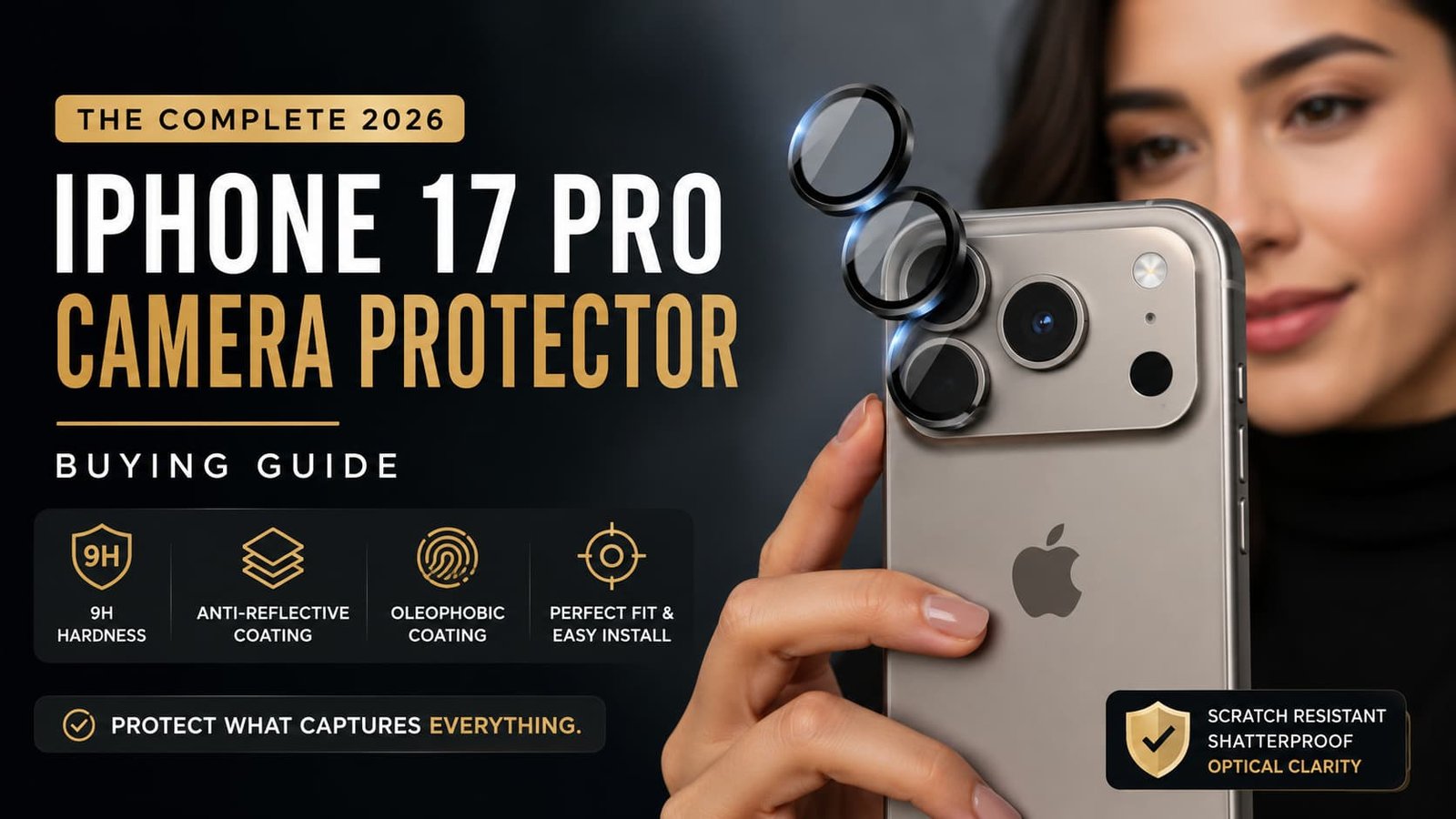
iPhone 17 Pro Camera Protector: The Complete 2026 Buying Guide
The iPhone 17 Pro is the most photographically ambitious smartphone Apple has ever built. Released in September 2025, it arrived with a redesigned camera plateau spanning nearly the entire rear of the device, three 48-megapixel sensors across its wide, ultrawide, and telephoto lenses, an 8× optical zoom, and Apple’s 48MP Pro Fusion camera system a setup that DXOMARK and independent reviewers have confirmed as one of the strongest mobile camera platforms ever tested. If you spent $999 or more on a device built around this camera system, the lens array deserves protection that matches the quality of the hardware beneath it.
This guide covers everything you need to know about choosing, buying, and fitting an iPhone 17 Pro camera protector in 2026 from the materials that matter, to the specific features worth paying for, to the products that independent reviewers and everyday users have found most reliable since the phone’s launch.
Why the iPhone 17 Pro’s Camera Plateau Changes Everything About Lens Protection
Apple redesigned the camera section of the iPhone 17 Pro more radically than any previous generation. Gone is the raised square camera bump of the iPhone 15 and 16 Pro models. In its place is a horizontal rectangular plateau that runs nearly edge to edge across the back of the phone. The three camera lenses sit on the left side of this plateau, and the LiDAR scanner and flash module have been repositioned to the right.
This is not a cosmetic change it is a structural one with direct consequences for lens protection:
- Larger exposed surface area. The plateau is wider and flatter than previous camera bumps, which means more glass is exposed and traditional bump-only protectors no longer cover the full system.
- New lens positioning. The horizontal arrangement of the three lenses requires protectors purpose-built for the iPhone 17 Pro layout, not adapted from iPhone 16 Pro designs.
- LiDAR and flash are now separate. Camera protectors that cover only the lens array no longer risk obstructing the flash or LiDAR sensor a common frustration with previous-generation protectors that is now resolved by design.
- 48MP sensors across all three lenses. Any optical degradation introduced by a low-quality protector now affects three high-resolution sensors simultaneously, making material quality more consequential than ever.
The practical implication: a generic lens protector purchased for a previous iPhone model will not fit the 17 Pro correctly. Only protectors designed specifically for the iPhone 17 Pro’s camera plateau geometry will align properly with the lens positions and the new plateau dimensions.
What Types of iPhone 17 Pro Camera Protector Are Available
The market for iPhone 17 Pro camera protection has organized itself into four distinct categories, each suited to a different priority profile:
Tempered glass protectors are the most widely used option. Rated at 9H hardness the same hardness rating used for screen protectors they offer genuine scratch and shatter resistance while maintaining high optical clarity. Thickness ranges from 0.2mm to 0.5mm. Thinner options (0.2–0.3mm) are case-compatible with most slim iPhone 17 Pro cases; thicker options may lift case edges slightly. Anti-reflective and oleophobic coatings are standard on quality tempered glass products, reducing fingerprint accumulation and lens flare in low-light shooting.
Metal ring protectors use raised aluminum frames to create a physical barrier around each lens without placing glass directly over the optical surface. They protect against scratches and minor impacts but offer no protection against direct shattering force. The advantage is zero optical interference the lens itself remains exposed to incoming light without any glass layer between subject and sensor.
Hybrid protectors combine a tempered glass center with a metal frame surround, delivering scratch resistance, shatter protection, and mechanical reinforcement in a single piece. These are the most comprehensively protective option and the most commonly recommended by independent reviewers for the iPhone 17 Pro’s high-value lens system.
Film protectors use thin flexible plastic rather than glass. They are the slimmest option and cause zero case compatibility issues, but they offer minimal impact resistance and scratch protection that degrades quickly with everyday use.
For the iPhone 17 Pro’s triple 48MP lens system, tempered glass or hybrid protectors represent the most defensible investment. A lens scratch that would have been inconvenient on a 12MP sensor becomes measurably more visible at 48MP and more expensive to explain to a repair technician.
The Features That Actually Matter When Buying
Not all iPhone 17 Pro camera protectors are created equal, and several marketing claims deserve scrutiny before purchase. The following are the features that independent testing and user experience confirm as genuinely meaningful:
- 9H hardness rating. This is the minimum standard worth purchasing. Products that list “high hardness” or “hardened glass” without specifying 9H should be treated with skepticism.
- Anti-reflective coating. This directly affects your photographs. A protector without an anti-reflective coating can introduce subtle flare in night shooting and reduce micro-contrast in bright conditions degradation that is difficult to detect in casual use but visible in close inspection of 48MP images.
- Oleophobic coating. Prevents fingerprint oil from smearing across the protector surface and migrating to the lens edge. Without it, the protector requires constant cleaning.
- Case compatibility rating. Confirm that the protector’s thickness is specified and compatible with any case you are using. Most slim iPhone 17 Pro cases accommodate protectors up to 0.3mm; thicker protectors may require a case-free installation or a case with an enlarged camera cutout.
- LiDAR and flash clearance. On the iPhone 17 Pro’s new plateau design, the LiDAR scanner and flash sit to the right of the lens array and are naturally separated. Confirm that the protector covers only the three lenses and does not extend into the LiDAR or flash zone.
- Installation alignment system. The iPhone 17 Pro’s lens positions require precise alignment during installation. Quality protectors include alignment frames or installation trays that position the glass exactly over each lens before pressing down. Products without alignment tools have a significantly higher rate of user-reported installation failures.
The Best iPhone 17 Pro Camera Protectors in 2026
Independent reviews from Digital Camera World, MacObserver, and case-tester.com converge on a consistent set of recommendations for the iPhone 17 Pro platform. The following represent the strongest options across different priority profiles.
FLOLAB 9H Anti-Reflective Camera Protector is the most recommended option for photographers who prioritize optical quality. FLOLAB’s protector is made from lab-tested 9H tempered glass with an anti-reflective coating verified not to degrade image quality across the iPhone 17 Pro’s three 48MP sensors. The oleophobic surface is among the most fingerprint-resistant in independent testing, and the lifetime warranty removes the financial anxiety from the purchase. The anti-reflective coating is the genuine differentiator night photography on the iPhone 17 Pro with FLOLAB’s protector installed shows measurably less lens flare than uncoated competitors.
ROXX Japanese 9H Camera Protector has earned consistent praise for its precise fit with the iPhone 17 Pro’s new plateau geometry and its dedicated attention to LiDAR and flash clearance. Unlike many competitors, ROXX covers only the three lenses precisely, leaving the flash and LiDAR sensor fully unobstructed. The Japanese-sourced 9H glass delivers high clarity in daylight and night conditions, and the color matching to the iPhone 17 Pro’s titanium finish is the closest available the protector is effectively invisible in normal use.
Torras Diamond Shield is the option for users who prioritize impact resistance above all else. Built to MIL-STD-810G standards, it is shatterproof under drops from up to eight feet and includes an anti-glare coating that improves photo visibility in direct sunlight. The Torras is slightly thicker than the FLOLAB and ROXX options, which requires verification against your specific case choice before purchasing.
CASETiFY Tempered Glass Camera Protector occupies a different market position it is the premium aesthetic option, with gem-style designs and metallic finishes that complement the iPhone 17 Pro’s titanium chassis. Optically, it maintains high clarity and includes an anti-fingerprint coating, making it a genuinely functional as well as decorative choice for users who want their protection to be part of the phone’s visual identity rather than invisible.
For a comprehensive breakdown of the full range of options available for the Pro Max variant, the iPhone 17 Pro Max camera protector guide at covers the additional considerations that apply to the larger device, where the plateau dimensions and lens positions differ slightly from the standard Pro.
How to Install Your iPhone 17 Pro Camera Protector Correctly
Installation is the step where most camera protector purchases succeed or fail. The iPhone 17 Pro’s three-lens array requires precise alignment across all three optical surfaces simultaneously, and a misaligned protector that admits dust or leaves air gaps under one lens compromises both protection and image quality.
The correct process:
Before you begin: Clean the camera plateau thoroughly with the alcohol wipe included in your protector kit. Follow immediately with the dry microfiber cloth to remove any residue. Hold the phone under a bright light and confirm no dust particles remain on or around the lens surfaces. A single dust particle trapped under a camera protector is visible in photographs taken at full 48MP resolution.
Alignment: Place the alignment frame or installation tray over the camera plateau before removing the adhesive backing from the protector. Confirm that the cutouts in the alignment frame sit precisely over each lens, the LiDAR scanner, and the flash. Adjust until the alignment is exact.
Application: With the alignment frame holding position, remove the backing and lower the protector onto the plateau. Press firmly from the center of each lens outward to expel any air bubbles. The adhesive on quality 9H tempered glass protectors is self-setting do not attempt to lift and reposition after the initial contact.
Case fit: Before fitting your iPhone 17 Pro case, confirm that the case’s camera cutout clears the edges of the protector without pressing on it. A case that presses on the protector edge can cause micro-cracking that is not immediately visible but compromises protection over time.
If one lens produces visibly softer images than the others after installation, the protector over that lens has been applied at an angle or with a micro-bubble beneath it. Remove and replace that individual lens protector most quality kits include a spare.
Camera Protector and Case: Getting Both Right
An iPhone 17 Pro camera protector does not replace a quality case the two work as a system. The plateau’s new horizontal design means that standard iPhone 17 Pro cases need a wider camera cutout than previous generations, and not all cases on the market have been updated for the 17 Pro’s specific dimensions.
Before purchasing a camera protector, confirm that your existing case has a camera cutout that accommodates the protector’s thickness without pressing on its edges. If you are purchasing both a case and a protector simultaneously, check the protector’s specified thickness typically stamped on the packaging and cross-reference it with the case manufacturer’s camera cutout specifications.
If you are using one of the iPhone 17 Pro’s strongest camera-centric cases, the best iPhone for camera guide at Techlspro provides a useful reference for understanding which iPhone models and case combinations deliver the highest overall photographic output context that helps calibrate how much lens protection investment is appropriate for your shooting habits.
Does a Camera Protector Affect iPhone 17 Pro Image Quality?
This is the question every photographer asks before purchasing, and the honest answer is: it depends entirely on the quality of the protector.
A high-quality 9H tempered glass protector with a certified anti-reflective coating and optical-grade clarity such as those from FLOLAB, ROXX, or similar verified manufacturers produces no measurable degradation in image quality under standard testing conditions. Independent optical tests confirm that 9H glass of sufficient quality does not reduce effective resolution, introduce color shifts, or compromise dynamic range on the iPhone 17 Pro’s 48MP sensors.
A low-quality protector uncoated glass, imprecise fitting that causes micro-distortion at lens edges, or plastic film with inherent optical imperfections can and does affect image quality. The effect is most visible in:
- Night photography: Uncoated glass introduces additional lens flare elements in low-light scenes with point light sources streetlights, candles, neon signs that the iPhone 17 Pro’s computational photography system cannot fully compensate for.
- Macro photography: At the iPhone 17 Pro’s minimum focus distances, micro-distortion from edge misalignment is magnified and visible in the output frame.
- 8× telephoto shots: The 8× zoom setting crops deeply into the 48MP telephoto sensor. Any optical imperfection in the protector covering the telephoto lens is proportionally magnified in the final image.
The conclusion from real-world testing is consistent: spend appropriately on a verified optical-quality protector, and the protection is invisible in your photographs. Cut corners on a $3 unverified option, and the compromise shows up in the images that the iPhone 17 Pro’s exceptional camera system was designed to capture.
For a deeper understanding of how the iPhone 17 Pro compares to previous Apple camera systems and what makes its optical hardware worth protecting, DXOMARK’s full camera test of the iPhone 17 Pro confirms that the 48MP Pro Fusion camera system across all three modules represents a significant leap in zooming capability and versatility context that underlines why lens integrity matters.
The latest independent coverage assessments and accessory reviews for the iPhone 17 Pro platform are well documented at MacRumors iPhone 17 Pro roundup, which covers hardware specifications, design changes, and the accessory ecosystem in depth. For optical quality standards and real-world camera protector testing methodology, Smartish’s iPhone lens protector guide provides a thorough breakdown of the four protector types, thickness considerations, and case compatibility the most technically complete guide available for the iPhone 17 Pro specifically.
Final Thoughts
The iPhone 17 Pro’s camera plateau is the most significant redesign of the iPhone’s rear camera architecture in years. Three 48-megapixel sensors, an 8× optical zoom, and a hardware system that DXOMARK ranks among the best ever tested in a smartphone all sit behind a lens array that is exposed to the same daily hazards as every phone that came before it keys, sand, concrete, and the accumulated abrasion of real-world use.
A quality iPhone 17 Pro camera protector is not an accessory that diminishes the phone’s design or compromises its photographic capability. It is the layer between a $999 optical investment and the scratches, drops, and particles that will attempt to reach it every day. Choose a protector with verified 9H tempered glass, an anti-reflective coating, precise alignment tools, and confirmed case compatibility, and the protection becomes invisible in daily use and in every photograph you take.
The camera plateau changed what iPhone protection looks like. The best camera protectors for 2026 have kept pace with that change.

- How Many Weeks Between Two Dates? A Simple, Accurate Guide - October 16, 2026
- What Elements Are Foundational for SEO with AI? The Two-Layer Framework for 2026 - October 15, 2026
- 9 Best HARO Alternatives in 2026 (After HARO Shut Down) - October 15, 2026