
How to Track ChatGPT Rankings Over Time in 2026
Learning how to track ChatGPT rankings over time requires a different approach from traditional Google rank tracking. ChatGPT does not present a fixed list of organic positions where a website stays at number one, number two, or number three. Instead, your visibility can be measured through brand mentions, citations, cited pages, competitors, prompt coverage, and changes in how your website appears in AI-generated answers.
For SEO professionals, publishers, and businesses, the goal is therefore not to chase a single ChatGPT ranking number. The goal is to build a repeatable system that shows whether your visibility in relevant ChatGPT answers is increasing, declining, or remaining stable.
This guide explains how to track ChatGPT rankings over time, which metrics matter, how to build a useful prompt set, which tools can help, and how to turn the results into practical SEO improvements.
What Does a ChatGPT Ranking Actually Mean?
Traditional search engines provide relatively clear ranking positions. If a page ranks in position three for a keyword, you can usually identify that position on the search results page.
ChatGPT works differently. When ChatGPT Search uses the web, responses can include links and citations to relevant sources. The answer can also change depending on the prompt, context, available web information, and other factors.
That means a more useful definition of a ChatGPT “ranking” is your website’s visibility within a defined set of prompts.
| Metric | What It Measures |
|---|---|
| Brand Mention | Whether ChatGPT mentions your brand in an answer. |
| Citation | Whether ChatGPT links to your website or page as a source. |
| Cited Page | Which specific URL from your website is referenced. |
| Prompt Visibility | How frequently your brand appears across the prompts you monitor. |
| Competitor Visibility | How often competitors appear for the same prompts. |
| Answer Context | How ChatGPT describes your brand, product, service, or content. |
For a reliable long-term measurement system, record these metrics consistently instead of treating one ChatGPT response as a permanent ranking.
Why Track ChatGPT Visibility Over Time?
A single ChatGPT check can be useful, but it does not tell you whether your overall AI visibility is improving. AI-generated answers can change, and a website that appears for one prompt may not appear for another closely related prompt.
Tracking the same group of commercially important and informational prompts on a regular schedule gives you a much stronger dataset.
For example, you may discover that your website:
- appears frequently for informational questions but rarely for commercial comparisons;
- is mentioned by ChatGPT but another website is more frequently cited;
- has strong visibility for one topic cluster but weak visibility for another;
- is losing visibility to a competitor after a content change;
- has individual pages that are repeatedly cited and other pages that are almost never referenced.
These observations can guide content updates, internal linking, digital PR, topical coverage, and technical SEO decisions.
How ChatGPT Search Can Surface Website Content
ChatGPT Search can retrieve current information from the web and provide links to relevant sources. OpenAI explains that ChatGPT Search may use search providers and other sources to find information, and responses can include citations that users can open and review.
For publishers, this creates an additional reason to maintain crawlable, useful, trustworthy, and clearly structured content. OpenAI also provides publisher guidance explaining that public websites can appear in ChatGPT Search and that websites should avoid unintentionally blocking OAI-SearchBot if they want their content to be discoverable and cited.
Read OpenAI’s publisher guidance for ChatGPT Search.
How to Track ChatGPT Rankings Over Time Step by Step
You do not need a complicated enterprise system to begin. A consistent process using a spreadsheet and a suitable AI visibility tool is enough for a small website.
1. Choose Your Most Important Topics
Start with topics that directly matter to your website rather than trying to monitor every possible question.
For Techlspro, these could include:
- ChatGPT SEO
- AI Mode rank tracking
- AI search visibility
- ChatGPT rank tracking tools
- AI SEO tools
- AI productivity tools
- AI tools for businesses
Prioritize topics that already generate impressions, rankings, clicks, or meaningful traffic in Google Search Console.
2. Build Prompt Clusters
Instead of tracking one keyword at a time, create groups of related questions.
For example, a ChatGPT rank tracking cluster could include:
- What are the best ChatGPT rank tracking tools?
- How can I track my website’s visibility in ChatGPT?
- What is the best AI search visibility tool?
- How can I monitor ChatGPT mentions?
- What tools track ChatGPT citations?
- How do I measure my brand visibility in ChatGPT?
This approach gives you a broader picture of your visibility for a topic rather than relying on a single prompt.
3. Record a Baseline
Before making major content changes, record your current results.
At minimum, record:
- the exact prompt;
- date checked;
- ChatGPT visibility;
- brand mention;
- citation;
- cited URL;
- visible competitors;
- brief notes about the answer.
Keeping the original prompt unchanged is important. If you rewrite the prompt every time, you may end up measuring changes in the question rather than changes in your visibility.
4. Repeat the Same Checks
Run the same important prompts on a regular schedule. Weekly or monthly tracking can work for smaller websites, while larger SEO teams may need more frequent monitoring.
The exact frequency matters less than consistency.
If your tool supports scheduled prompt tracking, use the same prompts and settings whenever possible. For example, Ahrefs Brand Radar supports custom prompts that can be monitored across AI assistants, including ChatGPT, with selectable refresh frequencies.
See how Ahrefs handles custom AI visibility prompts.
Which ChatGPT Visibility Metrics Should You Track?
There is no single metric that explains your complete AI search performance. A small group of related metrics is more useful.
| Metric | Why It Matters | What to Do If It Falls |
|---|---|---|
| Mentions | Shows whether ChatGPT recognizes your brand for relevant prompts. | Review topical authority, brand coverage, and supporting sources. |
| Citations | Shows whether your website is being used as a source. | Improve the usefulness, clarity, originality, and authority of relevant pages. |
| Cited URLs | Shows which pages are contributing to AI visibility. | Strengthen weak pages and improve internal linking. |
| Competitor Mentions | Shows which competitors are appearing for the same topics. | Study the content and sources associated with competitor visibility. |
| Prompt Coverage | Shows how consistently your brand appears across a topic cluster. | Expand content coverage around important subtopics. |
Best Tools for Tracking ChatGPT Rankings Over Time
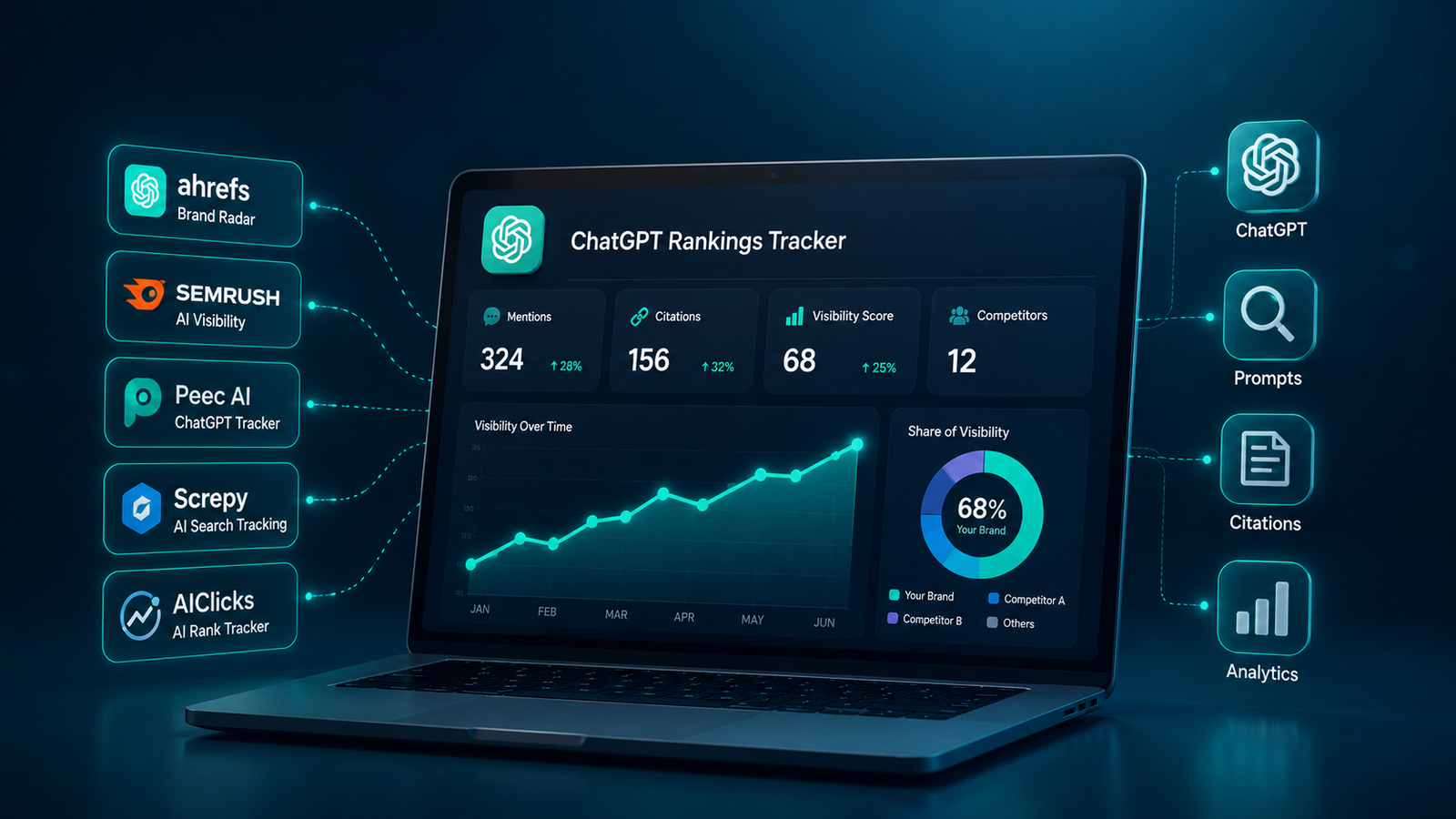
The right tool depends on how many prompts you need to monitor and whether you also want Google, AI Mode, Perplexity, and other AI platforms in the same workflow.
Ahrefs Brand Radar
Ahrefs Brand Radar provides AI visibility tracking across platforms including ChatGPT, Gemini, Perplexity, Copilot, and Google AI experiences. Its reporting includes metrics such as mentions, citations, impressions, and AI Share of Voice. It also supports custom prompts for focused tracking.
It is particularly useful when you want to compare AI visibility with broader SEO and content data.
Semrush AI Visibility Features
Semrush provides AI visibility features that allow users to monitor mentions across AI platforms such as ChatGPT and AI Mode alongside traditional Google search data. It supports custom keywords and prompts for tracking AI visibility.
This can be useful if your existing SEO workflow already depends heavily on Semrush.
See Semrush AI visibility features.
Peec AI
Peec AI focuses specifically on AI search visibility. Its ChatGPT visibility tracker provides reporting around brand mentions, query fanouts, opportunity scoring, and related AI visibility signals.
This type of specialized platform can be useful when your main objective is monitoring how your brand appears inside AI answers rather than managing traditional SEO rankings alone.
Explore Peec AI’s ChatGPT visibility tracker.
Manual Tracking
Manual tracking is still useful when you are starting out or have a small number of important prompts.
Create a spreadsheet with columns for:
- Date
- Prompt
- Brand mentioned
- Website cited
- Cited URL
- Competitors mentioned
- Answer notes
Once the number of prompts becomes difficult to manage manually, move to a dedicated tracking platform.
How to Track ChatGPT Rankings Without Confusing Them With Google Rankings
One of the biggest mistakes in AI SEO is treating ChatGPT visibility exactly like a Google position report.
Traditional Google tracking often asks:
What position does my page have for this keyword?
ChatGPT visibility tracking asks different questions:
- Does ChatGPT mention my brand?
- Does ChatGPT cite my website?
- Which page does it cite?
- Which competitors appear instead?
- For which prompts am I visible?
- Is my visibility improving across the topic cluster?
That distinction prevents you from creating misleading reports or assuming that one AI response represents a permanent ranking.
How to Find ChatGPT Visibility Gaps
Once you have collected enough observations, compare your results with competitors.
Suppose a competitor appears for eight out of ten prompts in a topic cluster while your website appears for only three. That gap is more useful than simply knowing that your website was absent from one response.
Look for patterns such as:
- topics where competitors consistently appear;
- questions where competitors are cited but you are only mentioned;
- questions where your brand is mentioned but your website is not cited;
- important commercial prompts where your competitors dominate;
- pages that repeatedly earn citations from AI answers.
These gaps can become a practical content and SEO roadmap.
How to Improve Your ChatGPT Visibility
There is no reliable formula that guarantees a website will be mentioned or cited in a particular ChatGPT answer. Instead, focus on improving the underlying quality and discoverability of your website.
Create Useful, Original Content
Google’s current guidance for generative AI search continues to emphasize unique, helpful, people-first content. Google specifically recommends creating content that adds original value rather than simply repeating information that already exists elsewhere.
Read Google’s guidance on optimizing for generative AI features.
Build Strong Topic Coverage
Do not create one page for every slight variation of a keyword. Instead, build comprehensive topic clusters that answer the main question and its important supporting questions.
For example, Techlspro can connect content about ChatGPT rank tracking, AI Mode tracking, ChatGPT mentions, and AI search visibility into a coherent topical network.
For more detailed information about monitoring website visibility specifically in ChatGPT, see our guide to ChatGPT site rank tracking software.
Improve Internal Linking
Internal links help users and search engines discover related content. They also make your website’s topic structure clearer.
For example, this article can naturally connect to:
- ChatGPT site rank tracking software
- best AI Mode rank tracker tools
- tools for monitoring ChatGPT mentions
- AI search visibility tools for businesses
- Perplexity SEO tracking tools
Only add a link when the destination genuinely helps the reader. Avoid inserting internal links simply to increase the number of links on the page.
Strengthen Your External Authority
AI visibility does not exist independently of the wider web. Your brand and website can be represented across many sources, so building a credible online presence matters.
Focus on legitimate editorial mentions, useful original research, expert contributions, relevant industry coverage, and high-quality references rather than creating artificial mentions.
How to Turn ChatGPT Tracking Into a Monthly SEO Workflow
For a small website, you can keep the process simple.
| Frequency | Task |
|---|---|
| Weekly | Check your highest-priority prompts and note major visibility changes. |
| Monthly | Compare mentions, citations, cited pages, and competitors. |
| Monthly | Review pages that gained or lost visibility. |
| Quarterly | Identify larger topic gaps and update important content. |
This workflow is more useful than checking ChatGPT randomly and trying to remember what appeared in previous answers.
How to Connect ChatGPT Visibility With Google Search Console
ChatGPT tracking should complement, not replace, traditional SEO measurement.
Use Google Search Console to understand:
- which pages receive Google impressions;
- which queries generate visibility;
- which pages are moving toward page one;
- where your existing content has search demand.
Then use ChatGPT visibility tracking to investigate whether those important topics also produce AI visibility opportunities.
Google has also introduced dedicated Search Console reporting for visibility in generative AI features such as AI Overviews and AI Mode, although availability can vary as these reports roll out.
Learn about Google’s generative AI performance reports in Search Console.
Common Mistakes When Tracking ChatGPT Rankings
- Checking only one prompt: One response is not enough to measure a topic.
- Expecting fixed rankings: ChatGPT visibility is not equivalent to a traditional SERP position.
- Changing prompts every time: Keep your core tracking prompts consistent.
- Ignoring competitors: Your visibility is more meaningful when compared with competing brands.
- Tracking mentions without citations: A brand mention and a website citation are different signals.
- Ignoring the cited URL: Knowing which page ChatGPT references can reveal which content is performing well.
- Using unsupported statistics: Avoid claiming exact AI accuracy or ranking improvements without reliable evidence.
- Creating content only for AI systems: Continue following people-first SEO principles.
Frequently Asked Questions
Can I track ChatGPT rankings like Google rankings?
Not exactly. ChatGPT does not provide a traditional fixed ranking position for every website. A better approach is to track brand mentions, citations, cited URLs, prompt coverage, competitors, and visibility trends across a consistent set of prompts.
What should I measure when tracking my website in ChatGPT?
Start with brand mentions, website citations, cited pages, competitor visibility, and the percentage of your tracked prompts where your brand appears. These metrics provide a more useful picture than a single ranking number.
How often should I check my ChatGPT visibility?
For a small website, weekly or monthly checks can be sufficient. The important part is to keep your core prompts consistent so that you can compare results over time.
Can Google Search Console show my ChatGPT rankings?
Google Search Console does not provide a traditional report for your rankings inside ChatGPT. Use Search Console for Google Search performance and a dedicated AI visibility tracker or controlled manual process for ChatGPT monitoring.
Can ChatGPT cite my website?
Yes. ChatGPT Search can provide links to web sources in responses. Whether your website is mentioned or cited depends on the query, available web information, relevance, and other factors. There is no guaranteed method for earning a citation for a particular prompt.
What is the easiest way to start tracking ChatGPT visibility?
Start with 10 to 20 important prompts related to your main topics. Record the date, whether your brand was mentioned, whether your website was cited, which URL was cited, and which competitors appeared. Repeat the same checks regularly and look for trends rather than isolated results.
Final Thoughts
Learning how to track ChatGPT rankings over time is really about building a reliable AI visibility measurement system. Instead of trying to assign your website a permanent position inside ChatGPT, monitor the signals that can actually be observed: mentions, citations, cited pages, prompt coverage, competitors, and changes over time.

- How to Add Captions to Short Videos That People Actually Read - October 8, 2026
- 10 Step AI Search Content Optimization Checklist - October 6, 2026
- Competitor Visibility Tracker: How to Monitor Search and AI Visibility - August 22, 2026






Pingback: AI Mode Rank Tracking Software: 10 Best Tools Compared For 2026