
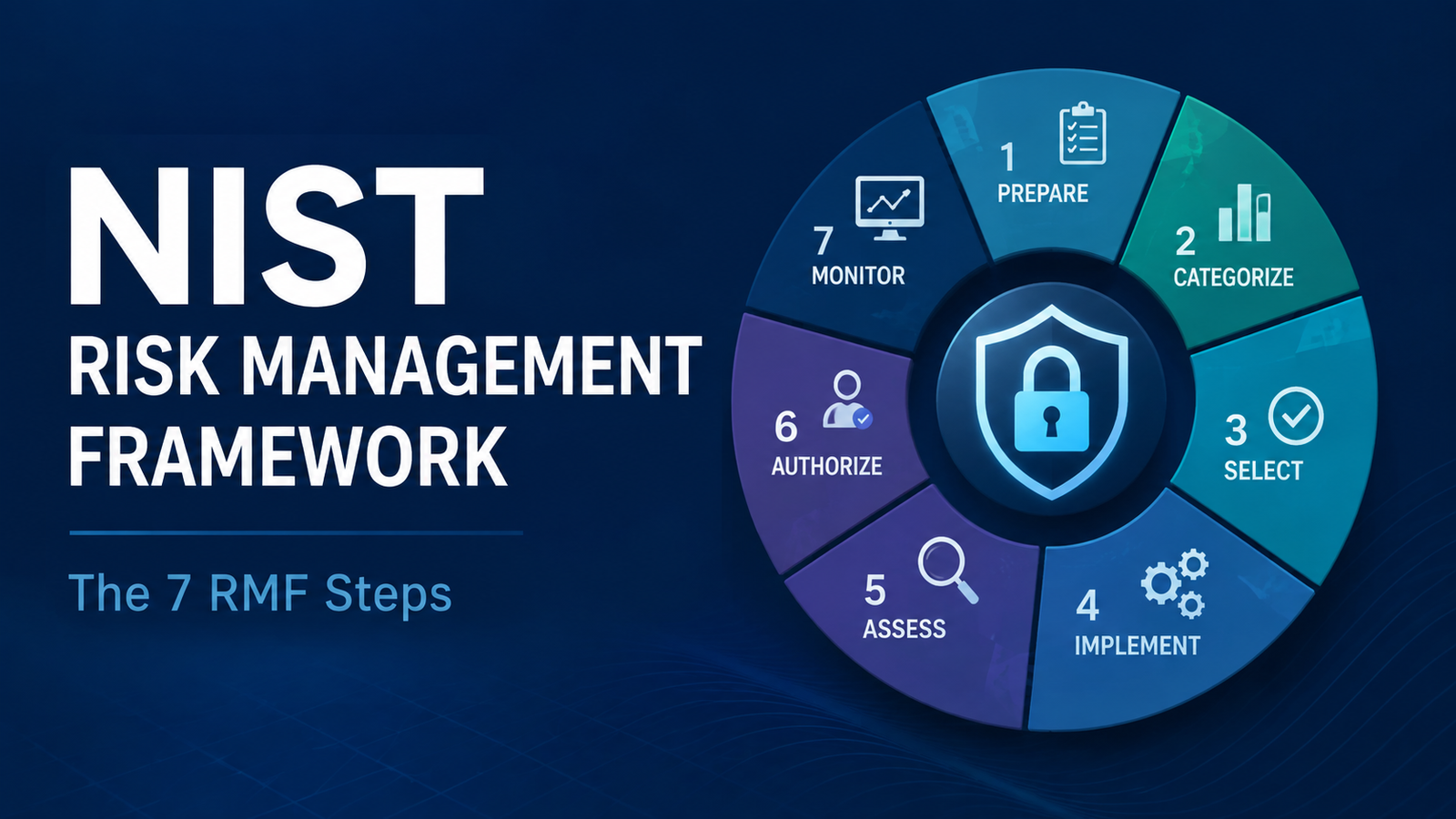
NIST Risk Management Framework: The Complete Guide for Organizations in 2026
The NIST Risk Management Framework provides organizations with a structured, repeatable process for managing cybersecurity and privacy risks across information systems and the broader enterprise. Developed by the National Institute of Standards and Technology, the framework has become the foundational approach for federal agencies and a well-regarded model for organizations seeking a credible, well-documented method for identifying, managing, and continuously monitoring risk. Whether you are a compliance officer encountering the RMF for the first time or a security architect implementing it across a complex environment, this guide explains how the framework works, why it matters, and how to apply it effectively.
What Is the NIST Risk Management Framework?
The NIST Risk Management Framework is a seven-step process that integrates security, privacy, and supply chain risk management activities into the system development lifecycle. It is formally documented in NIST Special Publication 800-37 Revision 2, titled “Risk Management Framework for Information Systems and Organizations.” It was published in December 2018, and NIST currently lists SP 800-37 Rev. 2 as the final RMF publication.
The framework was originally developed to help United States federal agencies comply with the Federal Information Security Modernization Act (FISMA), but its applicability extends well beyond government. Private companies, healthcare organizations, defense contractors, higher education institutions, and international organizations may use the RMF as a structured approach to managing security and privacy risk.
At its core, the NIST RMF is not a one-time compliance checklist. It is a continuous, disciplined process that ensures security controls are selected appropriately, implemented correctly, assessed rigorously, and monitored over time. Organizations that treat the RMF as a living operational process rather than a documentation exercise are the ones that see meaningful reductions in security risk.
It is worth clarifying an important distinction here. The RMF itself defines the process and steps. A separate NIST publication, SP 800-53, provides the catalog of security and privacy controls that organizations draw from during the Select step. Understanding that these are two different documents serving different purposes prevents a great deal of confusion for teams new to the framework.
Why Organizations Choose to Use the NIST RMF
The appeal of the NIST RMF extends beyond regulatory compliance. Organizations adopt it for several practical reasons that go beyond satisfying auditors.
First, the framework provides a common language for discussing risk across departments. When legal, IT, operations, and executive leadership all reference the same framework, risk conversations become more productive. The RMF creates a shared vocabulary that bridges technical and business perspectives.
Second, the framework is flexible enough to apply to systems of different sizes and complexities. A small web application and a large enterprise data platform can both be managed through the same RMF process, with appropriate tailoring at each step.
Third, organizations that work through the RMF process accumulate a documented security posture that supports third-party audits, contracts with government clients, and internal governance reviews. The documentation produced through the RMF is itself a valuable organizational asset.
Finally, for organizations operating in environments where emerging technology threats are escalating including AI-driven threats, synthetic media attacks, and infrastructure vulnerabilities the RMF provides a methodology for systematically identifying and responding to new risk categories as they appear. Understanding how to prevent deepfakes and similar technology-enabled threats, for example, becomes part of the risk identification work that happens during the Prepare and Categorize steps.
Who Can Use the NIST Risk Management Framework
While the RMF was designed with federal agencies in mind, NIST SP 800-37 Rev. 2 explicitly expanded its intended audience. The document states that the framework applies to federal agencies, state and local governments, contractors supporting government programs, private sector organizations, and international partners.
In practice, the framework is applied across several contexts. Defense contractors supporting federal and Department of Defense programs may encounter RMF-based security and authorization requirements depending on the applicable contract and system. Healthcare organizations processing sensitive data may use the framework as a complement to HIPAA security requirements. Financial institutions reference it when building enterprise risk programs. Technology companies pursuing FedRAMP authorization which allows cloud services to be sold to federal agencies must complete a process derived directly from the RMF.
The framework is also scalable. Organizations of different sizes do not need the same documentation depth. The RMF accommodates varying organizational contexts through tailoring guidance that allows proportional application without abandoning the underlying rigor.
The Seven NIST Risk Management Framework Steps
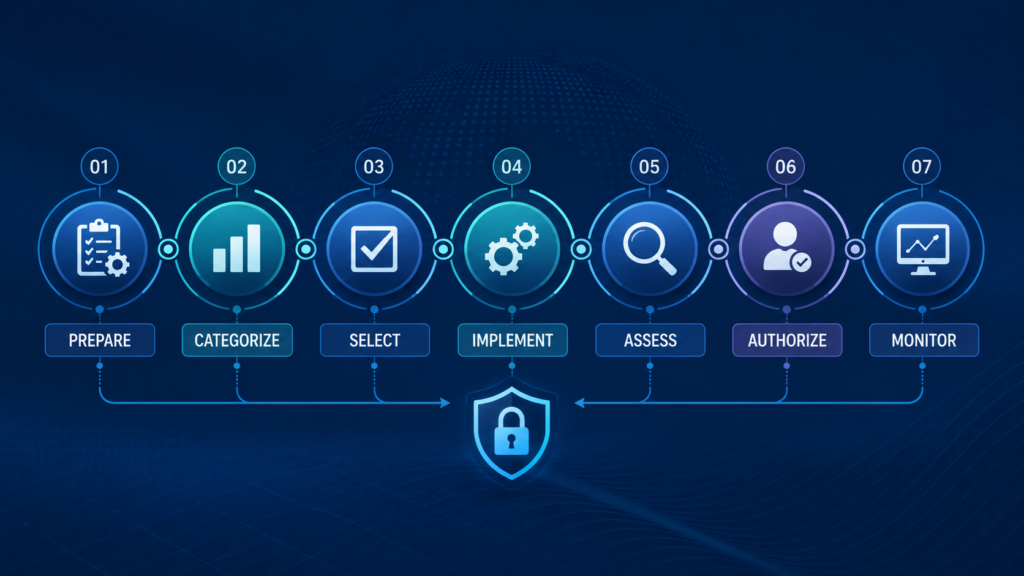
The most important thing to understand about the RMF steps is that they are not a linear process completed once and filed away. They form a cycle, with ongoing monitoring feeding back into earlier steps as systems change, threats evolve, and organizational priorities shift. Here is how each step works in practice.
Step 1: Prepare
The Prepare step was introduced as a major change in Revision 2 of SP 800-37. It exists because NIST recognized that organizations were struggling with RMF implementation partly because foundational decisions had never been made at the organizational level before individual system teams tried to apply the process.
During Prepare, organizations establish the context and priorities that will inform all subsequent steps. This includes identifying key roles and responsibilities, documenting organizational risk tolerance, establishing a risk management strategy, inventorying the systems and assets that fall within scope, and setting up the governance structures that will oversee the process.
Prepare happens at two levels. At the organization level, leadership defines the overall risk strategy and priorities. At the system level, teams gather the system-specific information needed to move through the remaining steps efficiently. Skipping or rushing this step is one of the most common reasons RMF implementations stall later in the process.
Step 2: Categorize
During the Categorize step, each information system is evaluated based on the potential impact of a security or privacy breach on the organization, its stakeholders, and the people whose data the system processes. NIST uses Federal Information Processing Standard 199 as the basis for categorization in the federal context, but the underlying logic assessing impact based on confidentiality, integrity, and availability applies broadly.
Systems are assigned a Low, Moderate, or High impact level for each of these three objectives. The highest impact level across all three becomes the overall system categorization. A system categorized as High will require more extensive security controls than one categorized as Low.
This step matters more than many teams initially realize. Miscategorizing a system as lower impact than warranted means selecting insufficient controls, which creates real security gaps. Overcategorizing drives unnecessary cost and effort. Getting the categorization right requires genuine understanding of what data the system handles and what the consequences of a compromise would be.
Step 3: Select
With a system categorization in hand, organizations move to the Select step, where they choose the security and privacy controls that will protect the system. NIST SP 800-53 provides the control catalog from which these selections are made. NIST SP 800-53B provides control baselines organized by impact level Low, Moderate, and High that serve as starting points for tailoring. Organizations then adjust those baselines by adding controls for specific threat environments and removing or adjusting controls that do not apply to their situation.
Control selection also involves identifying the system elements responsible for implementing each control. Some controls belong to the organization, some to the system owner, and some may be inherited from a shared service or cloud provider. Documenting these responsibilities clearly during the Select step prevents gaps and overlaps from appearing during implementation.
Step 4: Implement
The Implement step is where selected controls move from documentation into deployed reality. Security and IT teams configure systems, apply technical settings, establish procedures, train personnel, and deploy the actual protective measures that the Select step identified.
The documentation requirement during this step is significant. Organizations must record not just what controls were implemented but how they were implemented, including any deviations from the planned approach. This documentation serves as the evidence base for the next step and supports the authorization decision that follows.
Implementation quality varies considerably in practice. Controls that exist on paper but are not functioning as intended in the deployed environment are a persistent challenge. The Implement step requires technical precision and honest documentation of what was actually done rather than what was planned.
Step 5: Assess
The Assess step involves an evaluation of whether the implemented controls are operating effectively and achieving their intended security objectives. Assessors examine technical configurations, review documentation, interview personnel, and test controls through methods appropriate to the environment. NIST SP 800-53A provides detailed assessment procedures aligned to each control in SP 800-53.
Independence in assessment is important. Evaluation conducted solely by the same team that implemented the controls introduces bias that reduces the value of the findings. While not every organization can arrange a fully external assessment, the individuals conducting it benefit from sufficient separation from the implementation team to evaluate objectively.
Assessment findings are documented in a Security Assessment Report, which identifies controls that are functioning as intended, controls with weaknesses or deficiencies, and recommendations for remediation. This report directly informs the authorization decision in the next step.
Step 6: Authorize
Authorization is the formal decision by a senior official typically called the Authorizing Official to accept the residual risk associated with operating a specific information system. This step makes risk management an executive responsibility rather than a purely technical function.
The Authorizing Official reviews the assessment findings, examines the Plan of Action and Milestones that documents how identified weaknesses will be addressed, and makes a determination. An Authorization to Operate grants approval for the system to operate. A Denial of Authorization to Operate communicates that the risk level is unacceptable and the system requires remediation before it can operate.
This is one of the most consequential steps in the framework because it requires a named individual to formally accept accountability for the risk decision. The RMF authorization process creates documented accountability at the leadership level rather than implicit approval through inaction.
Step 7: Monitor
The Monitor step addresses the reality that security is not a static state. Systems change, threat landscapes evolve, and vulnerabilities that did not exist at authorization time emerge over the life of a system. Continuous monitoring ensures that the security posture assessed during the Assess step remains current and that new risks are identified and addressed promptly.
Monitoring activities include ongoing assessment of controls, reporting of security status to authorizing officials, responding to incidents, and triggering reauthorization when significant changes occur. NIST SP 800-137 provides additional guidance on information security continuous monitoring programs. Effective monitoring also integrates threat intelligence, vulnerability scanning, and configuration management into a continuous awareness program.
Organizations with mature monitoring capabilities often reduce the burden of periodic reauthorization because they maintain a near-real-time picture of system security posture rather than rebuilding that picture from scratch at fixed intervals.
NIST Risk Management Framework Examples in Practice
Understanding how the RMF works in real organizational contexts helps clarify how abstract framework concepts translate into operational decisions.
Consider a federal agency deploying a new cloud-based human resources system. During Prepare, the agency identifies the system owner, defines the authorization boundary, and documents that the system will process personally identifiable information for a large number of employees. During Categorize, the team determines that a confidentiality breach would have a High impact given the sensitive nature of personnel data, while availability is assessed as Moderate. The system is categorized as High overall based on the highest impact level across the three security objectives.
During Select, the team builds from the High baseline in SP 800-53B, adding controls specific to cloud environments and privacy protection requirements. Implementation involves configuring the cloud provider’s security features, establishing multi-factor authentication, encrypting data at rest and in transit, and creating incident response procedures specific to this system.
An independent assessment team reviews the implementation and identifies that audit logging was configured but logs were not being actively reviewed, flagging this as a control deficiency. The Plan of Action and Milestones includes a remediation timeline for establishing a log review process. The Authorizing Official reviews the findings, accepts the residual risk given the planned remediation, and issues an ATO for a defined period, subject to the organization’s authorization and monitoring requirements.
Ongoing monitoring includes regular vulnerability scans, periodic reviews of access privileges, and integration with the agency’s security operations center for continuous log analysis. When the HR system undergoes a significant update to add a new payroll module, the change triggers a reassessment to ensure the new functionality does not introduce unacceptable risk.
A Practical NIST RMF Sample Workflow for Smaller Organizations
Organizations that assume the RMF is designed only for large federal agencies sometimes abandon the framework before discovering how adaptable it is. A practical sample workflow for a mid-sized private organization might look like this.
Start by dedicating time to the Prepare step identify which systems are in scope, assign an owner to each, and document the organization’s overall approach to acceptable risk. Even a concise risk tolerance statement is more useful than none at all.
Use a categorization process appropriate to the organization’s context. A private company might use a tiered classification that reflects its own operational priorities and regulatory obligations while still applying the confidentiality, integrity, and availability impact model that FIPS 199 describes.
Select controls from NIST SP 800-53 using the SP 800-53B baselines as starting points. NIST designed those baselines to support organizations of different sizes and risk profiles. The key is making deliberate, documented selections rather than implementing controls in an ad hoc manner.
Document implementation consistently. A well-maintained record tracking which controls are implemented, how, and by whom is more useful than a formally structured document that was never completed.
Conduct an assessment with someone who was not directly involved in implementation. Even peer review catches errors that self-assessment misses.
Have a senior leader formally review the assessment results and make a documented decision about whether the residual risk is acceptable. This accountability step applies regardless of whether the organization uses federal ATO terminology or its own equivalent governance language.
Establish a monitoring cadence appropriate to the system’s risk level. Higher-risk systems warrant more frequent review. Automate monitoring activities where feasible to make the process sustainable over time.
How to Implement the NIST RMF Across Your Organization
Implementing the NIST RMF organization-wide is a different challenge than applying it to a single system. Enterprise-level implementation requires executive commitment, cross-functional coordination, and tooling that makes the process manageable at scale.
Start with governance. Assign clear ownership for the RMF program at the organizational level, establish a risk executive function responsible for policy and strategy, and create a process for managing the portfolio of system authorizations. Without organizational-level governance, individual system teams make inconsistent decisions that create gaps at the enterprise level.
Develop system inventory practices that can support ongoing RMF management. Organizations cannot effectively manage risk for systems they have not identified. A current, accurate system inventory is prerequisite infrastructure for an effective RMF program.
For organizations managing AI infrastructure and cloud-based systems at scale, the supply chain risk management components introduced in SP 800-37 Rev. 2 become especially relevant. Understanding the security posture of technology providers and the risks introduced by dependencies on external platforms is a core part of the Prepare step at the organizational level. Organizations evaluating the security implications of AI infrastructure investments may find it useful to understand how AI infrastructure support intersects with enterprise operational and security risk management considerations.
Train personnel at appropriate levels. System owners, security officers, developers, and executives all have different roles in the RMF process and benefit from training tailored to those roles. Generic security awareness training is insufficient preparation for the specific responsibilities each group carries within the framework.
Emerging Threats and the RMF
The RMF’s flexibility is particularly useful in environments where threat landscapes are evolving. Risk categories that require careful attention in 2026 including AI-generated attacks, deepfake-based identity fraud, and synthetic media manipulation can be incorporated into the risk management process through the framework’s existing structure.
During the Categorize step, teams can address the impact of emerging technology threats on the systems they are evaluating. During Select, controls addressing identity verification, content authenticity, and access management can help mitigate risks from synthetic media attacks. Organizations working through their risk identification process may find guidance on protecting against deepfake threats useful as context for understanding the kinds of digital identity risks that modern systems may need controls to address.
The Monitor step is also where organizations can establish ongoing awareness of emerging threat categories, ensuring that new attack vectors identified after authorization trigger appropriate review rather than going unaddressed until the next scheduled assessment cycle.
NIST RMF Documentation and PDF Resources
Organizations implementing the RMF should work directly from NIST’s official publications rather than third-party summaries that may be outdated or inaccurate. The primary reference document is NIST Special Publication 800-37 Revision 2, which is available at no cost from NIST’s Computer Security Resource Center.
The official NIST Risk Management Framework project page provides access to the framework documentation, related publications, training resources, and supplementary materials. This should be the first reference for any organization seeking authoritative information about the framework.
The full text of NIST SP 800-37 Rev. 2 is available as a free PDF download from NIST’s publication library. The document includes the complete framework description, detailed guidance for each step, appendices covering role definitions and supporting processes, and references to related publications including SP 800-53, SP 800-53A, SP 800-53B, SP 800-30, and SP 800-137.
Organizations frequently ask about NIST RMF sample documentation templates. NIST does not publish official templates, but the Federal Chief Information Security Officer Council and various federal agencies publish sample system security plan templates and authorization package guides that organizations can use as starting points for building their own documentation practices.
NIST Risk Management Framework Updates and Publication History
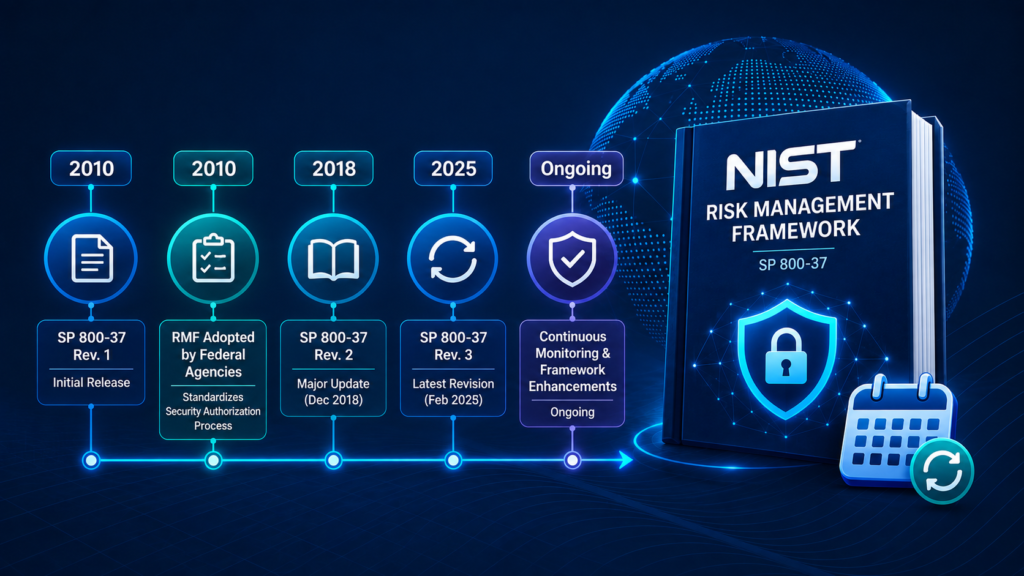
Understanding the publication history of the RMF helps organizations identify when their current practices may reflect outdated guidance.
The original NIST RMF was introduced through SP 800-37 Revision 1, published in February 2010. That version defined six steps: Categorize, Select, Implement, Assess, Authorize, and Monitor. It established the RMF as the federal government’s standard approach to information system security authorization.
SP 800-37 Revision 2, published in December 2018, introduced several significant changes. The most structurally important was the addition of the Prepare step, which became Step 1 in the revised framework. This change responded to practical experience showing that organizations struggled to implement the RMF effectively without establishing organizational-level context before system-level work began.
Revision 2 also added explicit privacy risk management integration, reflecting the growing importance of privacy as a distinct risk dimension alongside security. Supply chain risk management received more detailed treatment, addressing risks introduced by technology products and services acquired from external providers.
The 2018 revision also aligned the RMF more closely with the NIST Cybersecurity Framework, NIST Privacy Framework, and the systems engineering principles in SP 800-160, creating a more cohesive set of NIST guidance for organizations building comprehensive risk management programs.
Organizations should verify the current status of NIST publications directly through NIST’s official Computer Security Resource Center to ensure they are referencing the most current guidance.
Common Mistakes Organizations Make When Implementing the NIST RMF
Treating the RMF as a paperwork exercise. The framework requires documentation, but documentation is not the goal. Organizations that focus on producing authorization packages without genuinely improving their security posture produce compliance activity rather than real risk reduction. Controls need to function in the deployed environment, not just on paper.
Skipping or minimizing the Prepare step. Many teams still treat Prepare as an optional formality. The organizational decisions made during Prepare directly affect the quality of every subsequent step. Making those decisions ad hoc throughout the process creates inconsistency and gaps that become costly to resolve later.
Miscategorizing systems to reduce documentation burden. Categorizing a system below its appropriate impact level leads to insufficient controls and real security gaps. The pressure to reduce workload by categorizing conservatively is understandable but counterproductive to the framework’s purpose.
Treating assessment as a formality. Assessments conducted by implementation teams, or by assessors who feel pressure to produce favorable results, reduce the value of independent verification. Authorizing Officials should understand that favorable assessments from non-independent sources are not reliable evidence of actual system security.
Treating authorization as a destination rather than a point in an ongoing process. Organizations that achieve an ATO and reduce security attention until the next authorization cycle create risk exposure that grows throughout that period. The Monitor step exists precisely because security posture degrades over time without active maintenance.
Failing to document deviations from planned implementation. When a planned control cannot be implemented as designed, that deviation must be documented and addressed. Undocumented workarounds create a gap between the documented security posture and the actual one that assessors and Authorizing Officials cannot evaluate accurately.
Not maintaining a current system inventory. Organizations cannot manage risk for systems they have not identified. An inaccurate or incomplete system inventory means the RMF is applied to only part of the organization’s actual risk exposure.
Conclusion
The NIST Risk Management Framework provides a structured, disciplined, and flexible approach to managing the security and privacy risks that organizations face across their information systems. Its seven steps Prepare, Categorize, Select, Implement, Assess, Authorize, and Monitor form a continuous cycle rather than a one-time compliance exercise. Organizations that apply the framework with genuine operational intent, rather than treating it as a documentation burden, build security postures that are credible, defensible, and genuinely effective at reducing risk over time. Whether you are implementing the RMF to meet a federal requirement, satisfy a contractual obligation, or build a stronger internal risk management program, the investment in understanding and correctly applying each step pays dividends across the organization’s security and governance functions.
Frequently Asked Questions
What is the difference between the NIST RMF and the NIST Cybersecurity Framework?
The NIST Cybersecurity Framework is a higher-level, voluntary framework designed to help organizations improve their overall cybersecurity posture by organizing activities around five functions: Identify, Protect, Detect, Respond, and Recover. The NIST RMF is a more detailed process framework for managing risk at the information system level, with specific steps for categorizing systems, selecting controls, assessing those controls, and authorizing systems for operation. The RMF is required for federal information systems under FISMA. The two frameworks are designed to complement each other, and NIST has published guidance mapping their relationship.
Is the NIST RMF mandatory for private companies?
The NIST RMF is not broadly mandated for private companies. It is required for federal information systems and agencies under FISMA. Contractors supporting certain federal programs may encounter RMF-based requirements depending on the applicable contract. Some regulated industries reference NIST publications in their regulatory guidance, which can create indirect obligations in specific contexts. Private organizations that adopt the RMF voluntarily typically do so because it provides a credible, well-structured approach to risk management that satisfies a range of stakeholder expectations.
How long does it take to complete the NIST RMF process for a single system?
There is significant variation depending on system complexity, organizational maturity, and available resources. A straightforward system in an organization with established RMF practices might move through the process in two to three months. A complex, high-impact system in an organization implementing the RMF for the first time might take considerably longer. NIST and several federal agencies have published guidance on streamlining RMF timelines, focusing particularly on the Prepare step and on identifying which activities can proceed in parallel rather than strictly in sequence.
Where can I find official NIST RMF documentation and PDF resources?
The primary resource is NIST’s Computer Security Resource Center at csrc.nist.gov, which provides free access to SP 800-37 Rev. 2 and all supporting publications including SP 800-53, SP 800-53A, SP 800-53B, SP 800-30, and SP 800-137. NIST does not publish official authorization package templates, but several federal agencies and the Federal CISO Council publish sample documents that organizations can adapt for their own use.
What is an Authorization to Operate and how long does it last?
An Authorization to Operate is a formal decision by an Authorizing Official that a system’s residual risk is acceptable and the system may process, store, or transmit information. The duration of an ATO depends on the applicable authorization process and the organization’s specific requirements. Some traditional authorization approaches have used three-year periods as a common interval, but organizations with mature continuous monitoring programs may use ongoing authorization models where current security posture evidence replaces periodic point-in-time reassessment. An ATO is not a permanent certification it reflects the risk posture at a specific point and requires maintenance through the Monitor step.
What is a Plan of Action and Milestones in the RMF context?
A Plan of Action and Milestones documents how an organization plans to address security and privacy weaknesses identified during the assessment process. It records each deficiency, the planned remediation approach, the team responsible, and the target completion date. Authorizing Officials review the POA&M as part of the authorization package to understand what risks remain unmitigated and whether the remediation timeline is acceptable. The POA&M is a living document maintained throughout the system’s operational life and updated as weaknesses are resolved and new ones are identified.
How does the NIST RMF address privacy alongside security?
Revision 2 of SP 800-37 significantly expanded the framework’s treatment of privacy risk management, integrating it alongside security throughout each step. Organizations consider privacy risks during categorization, select privacy controls from SP 800-53’s privacy control families, assess privacy control effectiveness during the Assess step, and include privacy considerations in the authorization decision. This integration reflects the recognition that privacy and security risks often affect the same systems and require coordinated management rather than parallel but disconnected programs.

- How Many Weeks Between Two Dates? A Simple, Accurate Guide - October 16, 2026
- What Elements Are Foundational for SEO with AI? The Two-Layer Framework for 2026 - October 15, 2026
- 9 Best HARO Alternatives in 2026 (After HARO Shut Down) - October 15, 2026