
AI Book Writer Tool: 20 Best Free and Paid Platforms to Write Your Book in 2026
AI book writer tool platforms have transformed what is possible for authors in 2026. Whether you are a first-time writer struggling with a blank page or a professional author managing multiple projects simultaneously, the right ai book writer tool compresses months of drafting into weeks without sacrificing the voice, structure, or depth that readers expect. This guide covers 20 platforms ten genuinely free and ten worth paying for along with practical tips for getting professional-quality output from any tool you choose.
10 Free AI Book Writer Tools Worth Using in 2026
Free does not mean limited in 2026. Several platforms in this category deliver genuinely useful output without requiring a credit card, and the best ones offer enough functionality to complete a full manuscript draft before any paid upgrade becomes necessary.
1. Claude by Anthropic: The strongest free-tier ai book writer tool for raw prose quality. Its 200,000-token context window handles entire chapter drafts with coherent long-form reasoning that shorter-context tools cannot match. Best for literary fiction, essays, and complex non-fiction where argument depth matters more than template structure.
2. ChatGPT Free Tier: The most widely used ai book writer tool globally, running on GPT-4o-mini with message limits. Strong for outlining, chapter drafts, and overcoming writer’s block across virtually any genre or topic. The free tier produces usable first drafts that need human editing rather than publish-ready prose.
3. Google Gemini: The only major ai book writer tool requiring no account creation for basic use. Direct Google Docs integration eliminates copy-paste friction for writers already working in Google’s ecosystem. Best for quick chapter drafts and research-heavy non-fiction where Gemini’s web knowledge adds factual depth.
4. Inkfluence AI Free Tier: Purpose-built non-fiction ai book writer tool offering five chapters free monthly with built-in PDF export. Its blueprint system structures books by type guide, cookbook, lead magnet, how-to before generating, producing more coherent chapter sequences than general-purpose chatbots. You can start directly on the Inkfluence AI platform.
5. Perplexity AI: The best free research companion for non-fiction authors. Not a drafting tool but pairs powerfully with any ai book writer tool by providing cited, fact-checked summaries that prevent factual errors from entering manuscripts before submission.
6. NovelCrafter Free Tier: The strongest free ai book writer tool for organized fiction writers with its Codex feature storing characters, locations, and lore that the AI references automatically to maintain continuity across chapters. Supports bring-your-own-key connections to OpenAI and Anthropic models.
7. Poe by Quora: Provides free access to Claude, ChatGPT, and Gemini through a single interface, making it the most cost-effective multi-model ai book writer tool available without separate subscriptions. Writers can run the same chapter prompt through multiple models and combine the strongest elements.
8. Writesonic Free Tier: Covers individual chapter generation with multiple output variants per run, tone presets, and SEO keyword integration for authors writing non-fiction books targeting organic search traffic. Updated in 2026 with direct Shopify and WooCommerce integration for authors selling books through their own stores.
9. Type.ai Free Tier: Embeds AI directly inside a full document editor rather than a separate chat window, supporting documents up to 150,000 words with character and scene note storage. Offline mode and version history are included even on the free plan: significant advantages over browser-dependent tools.
10. Sudowrite Free Credits: The best free trial specifically for fiction, running on its proprietary Muse model fine-tuned on published novels. Free credits cover enough generation to properly evaluate whether the fiction-specific prose quality justifies the paid subscription for your genre and style.
10 Paid AI Book Writer Tools Worth the Investment
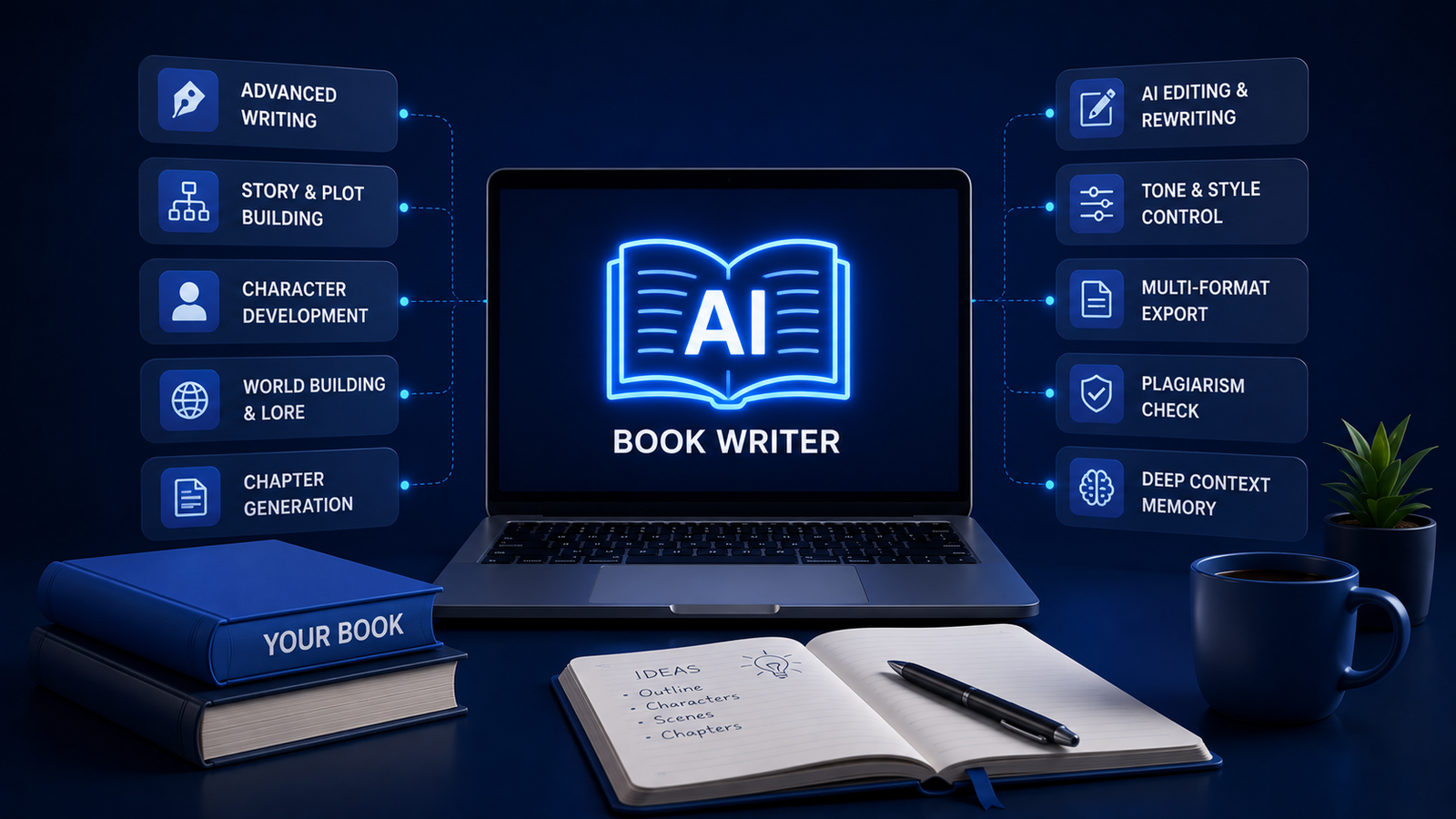
The paid category separates itself from free tools through persistent project memory, bulk generation capability, dedicated export formatting, and genre-specific training that general-purpose chatbots cannot match at scale.
11. Sudowrite Paid: The leading paid ai book writer tool for fiction authors, with Story Bible features, scene description tools, and the Muse model producing prose that consistently outperforms general-purpose models in blind testing for narrative fiction. Plans start at $19 per month. Full capabilities on the Sudowrite platform.
12. Jasper AI: The strongest paid ai book writer tool for non-fiction authors managing multiple client projects or book series simultaneously. Brand voice training replicates specific vocabulary and tone across entire manuscripts, and multi-brand support keeps separate book projects tonally isolated. Plans start at $39 per month.
13. Scrivener with AI Integration: The professional standard manuscript management tool now integrates with Claude and ChatGPT via third-party connectors, combining the strongest book organization infrastructure available with AI drafting capability. One-time purchase at $49 with no subscription required.
14. Atticus: Book formatting and AI drafting combined in one platform designed specifically for indie authors publishing to Amazon KDP, IngramSpark, and Smashwords. Its AI generates content within a structured chapter framework that exports directly to print-ready and ebook formats without additional formatting work.
15. Reedsy Book Editor with AI: Professional editorial platform combining AI drafting assistance with human editor marketplace access. Its export engine produces industry-standard EPUB and DOCX files that meet major publisher submission requirements without reformatting. Best for authors pursuing traditional publishing routes alongside AI-assisted drafting.
16. Shortly AI: Minimalist paid ai book writer tool designed specifically for long-form fiction and non-fiction drafting through simple slash commands rather than complex prompting. Writers type naturally and use /instruct commands to redirect the narrative, making it the least friction-heavy paid tool for sustained writing sessions.
17. Novelist AI: Paid ai book writer tool built specifically around the novel-writing workflow with persistent character databases, plot outlining, chapter-by-chapter generation, and continuity checking built into a single platform. Strong for romance, fantasy, and thriller authors managing large casts across multiple books in a series.
18. LivingWriter: Combines story structure templates based on proven narrative frameworks Save the Cat, Hero’s Journey, Story Circle with AI generation that fills in framework beats rather than generating structureless prose. Best for authors who struggle with plot architecture rather than prose production. Plans start at $9.99 per month. Full details on the LivingWriter platform.
19. Hypotenuse AI: The strongest paid ai book writer tool for non-fiction authors producing content books, business guides, and educational materials at scale. Its image-from-description generation and CSV bulk import capability make it particularly powerful for illustrated non-fiction and reference books with complex chapter structures.
20. Klynt AI: The newest premium ai book writer tool gaining significant traction in 2026 for screenplay and narrative non-fiction, offering scene-level generation with cinematic structure awareness and dialogue quality that general-purpose models handle inconsistently. Best for authors writing books with strong visual or dialogue-driven narrative elements.
A comprehensive resource covering free tools specifically, including setup workflows and prompt templates for zero-cost book drafting, is available through this free AI book writer generator guide that covers the complete workflow used by professional authors before investing in paid subscriptions.
Tips for Getting Professional Results From Any AI Book Writer Tool
The difference between publishable and generic AI-assisted manuscripts comes down almost entirely to how you use any ai book writer tool rather than which specific platform you choose.
- Write a detailed chapter outline before generating any prose the AI produces more coherent, targeted content when it knows exactly what a chapter must accomplish structurally rather than improvising from a vague topic description
- Generate in 500 to 800 word sections rather than asking for entire chapters at once smaller batches maintain prose quality and allow immediate review before continuity errors compound across longer generations
- Feed the tool your own writing samples before starting most platforms learn vocabulary, sentence rhythm, and tonal preferences from examples, producing output that sounds like you rather than generic AI prose
- Always read generated sections aloud before accepting them the phrasing errors and unnatural constructions that signal AI generation are far more obvious when heard than when read silently on screen
- Add one specific personal observation, data point, or real-world example to every generated section before moving forward specificity is what separates credible, readable AI-assisted books from generic content that readers abandon
- Budget genuine editing time rather than treating generation as a finished product professionally published AI-assisted manuscripts typically require ten to twenty hours of human revision regardless of how strong the initial output appears on first read
According to guidance published on the NovelCrafter blog, authors who invest in detailed character and world-building documentation before beginning AI generation consistently report higher satisfaction with output quality and significantly less revision time than those who prompt directly without pre-established story documentation.
Free vs Paid: Which AI Book Writer Tool Is Right for You
The decision between free and paid ai book writer tool options comes down to three factors: your manuscript length, your genre specificity requirements, and how much formatting and export infrastructure matters for your publishing path.
- Short non-fiction books and lead magnets under 30,000 words: Inkfluence AI free tier or Claude free tier covers the complete drafting workflow without a paid subscription
- Fiction novels requiring continuity management across 80,000-plus words: NovelCrafter or Sudowrite paid tiers address the context and character tracking limitations that free tools hit at scale
- Business books and educational content targeting Amazon KDP: Atticus combines AI drafting with KDP-optimized export formatting that free tools require a separate formatter to replicate
- Authors pursuing traditional publishing: Reedsy’s combination of AI assistance and professional editor access addresses both drafting speed and submission quality requirements simultaneously
For indie authors specifically, a detailed breakdown of which free ai book writer tool options deliver the most complete output at zero cost including export formats, word count limits, and genre performance comparisons is available through the Atticus indie author publishing blog, which covers AI writing tool integration across the full indie publishing workflow from draft to distribution.
Final Analysis
The twenty ai book writer tool platforms covered here span every meaningful author use case in 2026 from free general-purpose chatbots and fiction-specific prose generators to professional manuscript management platforms and indie publishing end-to-end solutions. No single tool is universally superior across every genre, word count, and publishing path, which is why matching the platform to your specific project type and production goal produces better outcomes than defaulting to whichever tool has the most downloads.
Start with the free tier of the platform that best matches your primary writing challenge, complete at least two to three chapters before evaluating output quality, and only commit to a paid subscription once you have real evidence that the specific features it adds justify the monthly cost against your actual drafting workflow.
Frequently Asked Questions
Can an AI book writer tool produce a complete manuscript ready for publishing?
AI tools can produce complete manuscript drafts, but publish-ready output requires human editing regardless of the platform. Most professionally published AI-assisted books require ten to twenty hours of revision covering voice consistency, factual accuracy, pacing, and the personal specificity that distinguishes readable books from generic content. Treat any ai book writer tool as a fast first-draft engine rather than a finished product generator.
Which AI book writer tool is best for first-time authors with no budget?
Claude’s free tier for prose quality combined with Inkfluence AI’s free tier for non-fiction structure covers the complete first-time author workflow without any payment. Claude handles chapter drafting with the strongest free-tier prose available, while Inkfluence provides the structural blueprint that first-time authors typically lack and the PDF export that eliminates manual formatting entirely.
Do AI book writer tools work for fiction and non-fiction equally well?
Most tools perform better in one category than the other. Sudowrite, NovelCrafter, and Novelist AI are specifically trained and designed for fiction and consistently outperform general-purpose tools on narrative prose, dialogue, and scene description. Inkfluence AI, Jasper, and Hypotenuse AI are stronger for non-fiction, business books, and educational content where structure, clarity, and information density matter more than narrative craft.
Is it legal to publish a book written with an AI book writer tool?
Yes. Amazon KDP, IngramSpark, and major publishers permit AI-assisted books with appropriate disclosure during the submission or publishing process. Amazon specifically requires AI content disclosure in its KDP publishing workflow as of 2026. Copyright ownership of AI-assisted work is retained by the human author making the creative decisions — the tool is treated as software assistance rather than authorship, provided meaningful human creative contribution is involved in the final manuscript.
How do I maintain my voice when using an AI book writer tool?
Provide writing samples from your existing work before generating any new content most platforms including Claude, Jasper, and NovelCrafter adapt their output to replicate your sentence rhythm, vocabulary preferences, and tonal patterns from examples you supply. Then add personal observations, specific details, and original insights to every generated section before moving forward. The combination of style-trained generation plus human specificity additions consistently produces manuscripts that sound authentically authored rather than obviously AI-generated.

- How Many Weeks Between Two Dates? A Simple, Accurate Guide - October 16, 2026
- What Elements Are Foundational for SEO with AI? The Two-Layer Framework for 2026 - October 15, 2026
- 9 Best HARO Alternatives in 2026 (After HARO Shut Down) - October 15, 2026