
AI Chatbot Tool: The Complete 2026 Guide to Smarter Business Conversations
AI chatbot tool adoption has crossed a critical threshold in 2026. What was once a novelty deployed on a handful of e-commerce sites is now a core infrastructure layer for businesses of every size handling support queues, qualifying leads, routing complex requests, and sustaining 24/7 customer engagement without adding headcount. Choosing the right AI chatbot tool today is no longer a question of whether you need one. It’s a question of which capabilities your workflows actually demand, and which platforms are genuinely built to deliver them at scale. This guide answers both questions with precision.
What Is an AI Chatbot Tool and How Has It Evolved?
An AI chatbot tool is a software system that uses natural language processing, machine learning, and increasingly large language models to simulate human conversation, answer questions, and complete tasks autonomously. The definition has expanded dramatically over the past two years. The first generation of chatbots followed rigid decision trees ask a question outside the script and the bot broke. Today’s AI chatbot tool operates differently: it retrieves information from knowledge bases, reasons across conversation context, integrates with backend systems, and takes actions like processing refunds, updating CRM records, or booking meetings without any human involvement.
- Rule-based chatbots follow fixed scripts and break on unexpected inputs
- NLP-powered AI chatbot tools understand intent and generate contextually appropriate responses
- Agentic chatbots (2025–2026) take multi-step actions inside connected systems autonomously
- The shift from deflection to resolution is the defining trend separating old chatbot platforms from modern AI chatbot tools
Why Every Business Needs an AI Chatbot Tool in 2026
Customer expectations have moved faster than most support teams can scale. Response time is no longer measured in hours users expect instant replies at any hour, across any channel they choose. An AI chatbot tool solves this gap structurally rather than by adding staff. According to Gartner, 80% of companies were already using or actively planning chatbot deployment in their customer service strategy as of 2025, a number that has continued to climb through 2026 as platform capabilities matured and pricing became more accessible.
The business case is grounded in measurable outcomes. HubSpot’s Breeze customer agent data shows organizations lowering support ticket volume handled by human reps by up to 77% after full deployment while simultaneously improving conversion rates through round-the-clock availability. These aren’t edge-case results. They reflect what happens when an AI chatbot tool is properly integrated with CRM data, product knowledge, and escalation workflows.
- Instant response across time zones eliminates the support gap that costs businesses leads and customer loyalty
- Parallel conversation handling lets a single AI chatbot tool manage hundreds of simultaneous queries with no degradation
- CRM-connected chatbots personalize every interaction using existing contact and deal history
- Cost per resolved ticket drops significantly as AI handles tier-one inquiries autonomously
Top AI Chatbot Tools Dominating 2026
The market in 2026 is not a sea of identical products. Each leading AI chatbot tool has a distinct strength profile, and the right choice depends entirely on your team size, technical capacity, channel requirements, and integration stack.
Intercom Fin is the clear leader for end-to-end AI support resolution. Rather than matching questions to scripted answers, Fin reasons across your entire knowledge base using a purpose-built retrieval engine and takes autonomous actions inside connected systems processing refunds, tracking orders, updating accounts without human handoff for resolvable issues.
Zendesk AI Agents come pre-trained on over 18 billion real customer service interactions, making them the fastest to deploy for teams already in the Zendesk ecosystem. No technical resources are required to get started, and the no-code builder allows custom conversation flows without engineering support.
HubSpot Breeze stands apart because it runs natively inside the HubSpot CRM, giving the AI chatbot tool full access to contact history, deal stage, and product data from the first message. For marketing and sales teams already on HubSpot, Breeze eliminates the training overhead that standalone chatbot platforms require.
IBM watsonx Assistant remains the enterprise standard for regulated industries needing governance, audit trails, and hybrid cloud deployment. IBM’s watsonx platform brings together foundation models, agent tooling, and enterprise security controls in a unified environment that scales from experimentation to production without rebuilding the architecture.
Tidio Lyro is the most accessible AI chatbot tool for small businesses and e-commerce brands. Lyro trains on your existing help center content and FAQ pages, deploys in under an hour, and handles common customer queries automatically at a price point that makes it viable even for early-stage teams.
AI Chatbot Tool Features That Actually Matter
Vendor marketing tends to emphasize surface-level features “conversational AI,” “smart routing,” “omnichannel support.” The features that determine whether an AI chatbot tool succeeds in production are more specific and less glamorous.
Knowledge grounding is the most critical capability. An AI chatbot tool must be able to restrict its answers to your approved content sources, cite those sources when responding, and escalate when confidence is low. Without proper grounding, chatbots hallucinate answers that damage trust and create liability.
Integration depth determines whether the tool can actually take action or only answer questions. Native connectors to your help desk, CRM, order management system, and authentication layer are non-negotiable for any AI chatbot tool expected to resolve issues rather than just deflect them.
- Simulation mode Test the AI against thousands of historical support tickets before going live with real customers
- Escalation controls Define natural-language rules for when the bot should transfer to a human agent, with full context intact
- Analytics dashboard Track resolution rate, escalation frequency, response time, and CSAT across all conversations
- Multilingual support Essential for global teams; leading platforms support 50+ languages natively in 2026
How to Deploy an AI Chatbot Tool Without Getting It Wrong
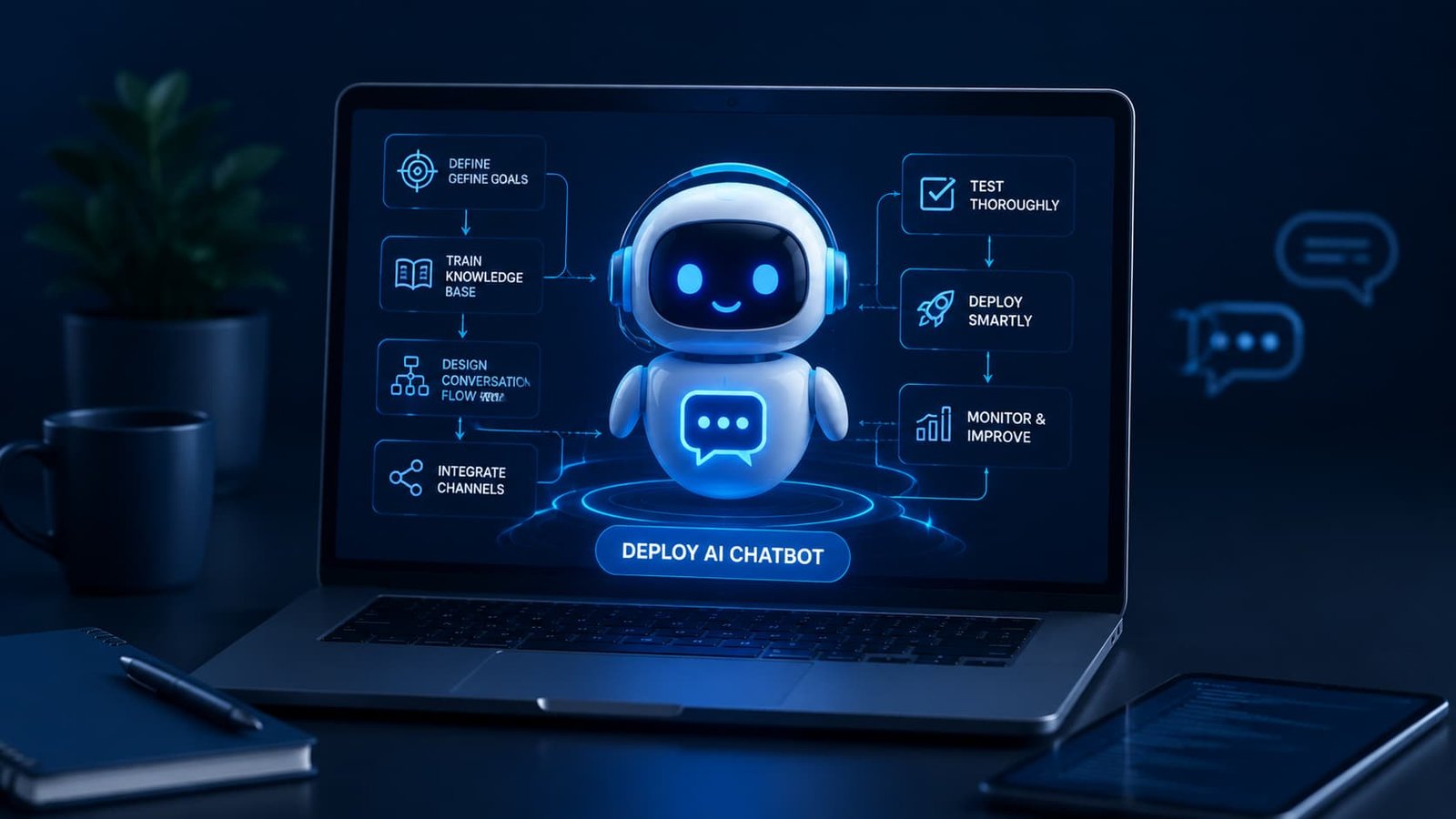
Most failed chatbot deployments share the same root cause: teams went live before the knowledge base was ready. An AI chatbot tool is only as accurate as the content it can access. Before launch, your help documentation needs to be current, organized by topic, and free of contradictory information. Every ambiguity in your knowledge base becomes a potential wrong answer in production.
The most successful deployments follow a phased approach. Start with the highest-volume, lowest-complexity inquiry category typically FAQs, order status, or account access questions. Get that working cleanly, measure the resolution rate, and expand from a position of proven performance rather than assumed capability.
For deeper guidance on selecting and integrating AI chatbot tools into your existing stack, the AI tools guide covers platform-by-platform breakdowns with workflow-specific recommendations.
AI Chatbot Tool Use Cases Generating Real ROI in 2026
Understanding where an AI chatbot tool delivers the highest return helps prioritize deployment scope. These are the use cases producing documented results across industries this year.
Customer support deflection remains the highest-volume use case. An AI chatbot tool trained on your help content can autonomously handle password resets, billing inquiries, shipping status checks, and product questions — freeing human agents for complex, revenue-impacting conversations that require judgment and relationship skills.
Lead qualification on inbound website traffic is equally high-value. Rather than letting visitors browse and leave, an AI chatbot tool can engage them with qualifying questions, capture contact details, route high-intent prospects to sales reps in real time, and book meetings directly on calendar without a human in the loop.
High-ROI AI chatbot tool deployment categories:
- Tier-one support deflection FAQ handling, order tracking, account management
- Inbound lead qualification Intent capture, CRM enrichment, meeting booking
- Internal employee support HR queries, IT help desk, onboarding workflows
- E-commerce cart recovery Proactive engagement with browsing visitors before they abandon
Pricing Models and What to Expect From an AI Chatbot Tool in 2026
Pricing has diversified significantly. The three dominant models in 2026 are per-resolution pricing (you pay only when the AI fully resolves a conversation), per-conversation pricing (charged for every interaction regardless of outcome), and seat-based pricing (a flat fee per user per month regardless of volume).
Per-resolution pricing pioneered by HubSpot Breeze at $0.50 per resolved conversation aligns cost directly with value delivered. It’s the most defensible model for teams that want automation ROI without paying for failed deflection attempts. Per-conversation models suit high-volume, low-complexity operations where resolution rates are predictably high. Seat-based models work best for internal-facing AI chatbot tools where conversation volume is tied to employee headcount rather than customer traffic.
According to HubSpot’s chatbot builder documentation, teams can get started with a functional AI chatbot tool at no cost, with paid tiers unlocking advanced CRM integration, AI-powered personalization, and multi-channel deployment across email, web chat, and social messaging platforms.
Enterprise AI Chatbot Tool Considerations: Security and Governance
Enterprise procurement teams evaluating any AI chatbot tool in 2026 are asking a consistent set of questions that weren’t on the checklist two years ago. Who owns the conversation data? Can the model be trained on proprietary content without that content being used to train a shared foundation model? What happens when the AI gives a wrong answer to a customer in a regulated industry?
Leading enterprise AI chatbot tools now address these concerns with explicit data isolation, SOC 2 Type 2 certification, contractual prohibitions on using customer data for model training, and role-based access controls. IBM watsonx, Zendesk AI, and HubSpot Breeze all publish model cards and trust documentation that security teams can review before approval.
- Require SOC 2 Type 2 certification as a baseline for any AI chatbot tool handling customer PII
- Confirm contractual data isolation your conversation data should never train shared models
- Evaluate audit logging depth every interaction should be traceable with full context for compliance review
- Test escalation behavior under edge cases before production what the bot does when it doesn’t know something matters as much as what it does when it does
Key Insights: What Teams Ask Before Choosing an AI Chatbot Tool
What is the fastest AI chatbot tool to deploy in 2026?
Tidio Lyro and Zendesk AI Agents are consistently the fastest to go live — both can be operational within a few hours using existing help center content, with no coding required.
Can an AI chatbot tool handle complex, multi-step customer issues?
Modern AI agents like Intercom Fin and Salesforce Agentforce can autonomously execute multi-step resolutions — processing refunds, updating accounts, and tracking orders — without human involvement. Rule-based chatbots cannot.
How do I prevent an AI chatbot tool from giving wrong answers?
Restrict the bot to verified knowledge sources, require citations in responses, set low-confidence escalation thresholds, and review conversation transcripts weekly to catch gaps before they become patterns.
Is there a free AI chatbot tool worth using in production?
HubSpot’s free chatbot builder offers a genuinely functional starting point for small teams, with CRM integration and lead qualification flows available at no cost. For higher volume or more complex workflows, paid tiers are necessary.
How does an AI chatbot tool differ from a live chat tool?
Live chat connects customers to human agents in real time. An AI chatbot tool handles conversations autonomously using artificial intelligence, with the option to escalate to a human when the issue exceeds its resolution capability. Most modern platforms combine both in a single interface.
Final Analysis
The AI chatbot tool landscape in 2026 has matured past the point where any serious business can justify not deploying one. The platforms are capable, the integration ecosystem is deep, and the pricing models have evolved to align cost directly with the value delivered. The critical variable is no longer access to technology — it’s the discipline to prepare your knowledge base before launch, choose a platform matched to your actual integration requirements, and measure resolution rate from day one rather than assuming the AI is working because volume appears to be handled.
Start with the highest-frequency, lowest-complexity support category in your operation. Measure clean. Expand deliberately. The teams generating the most measurable ROI from an AI chatbot tool in 2026 aren’t the ones who deployed the most features — they’re the ones who deployed the right features into workflows that were already well-documented and ready to be automated.

- How to Add Captions to Short Videos That People Actually Read - October 8, 2026
- 10 Step AI Search Content Optimization Checklist - October 6, 2026
- Competitor Visibility Tracker: How to Monitor Search and AI Visibility - August 22, 2026









Pingback: Agentic AI Tools List: 3 Categories Explained With Verified Picks For 2026